Artwork rationale
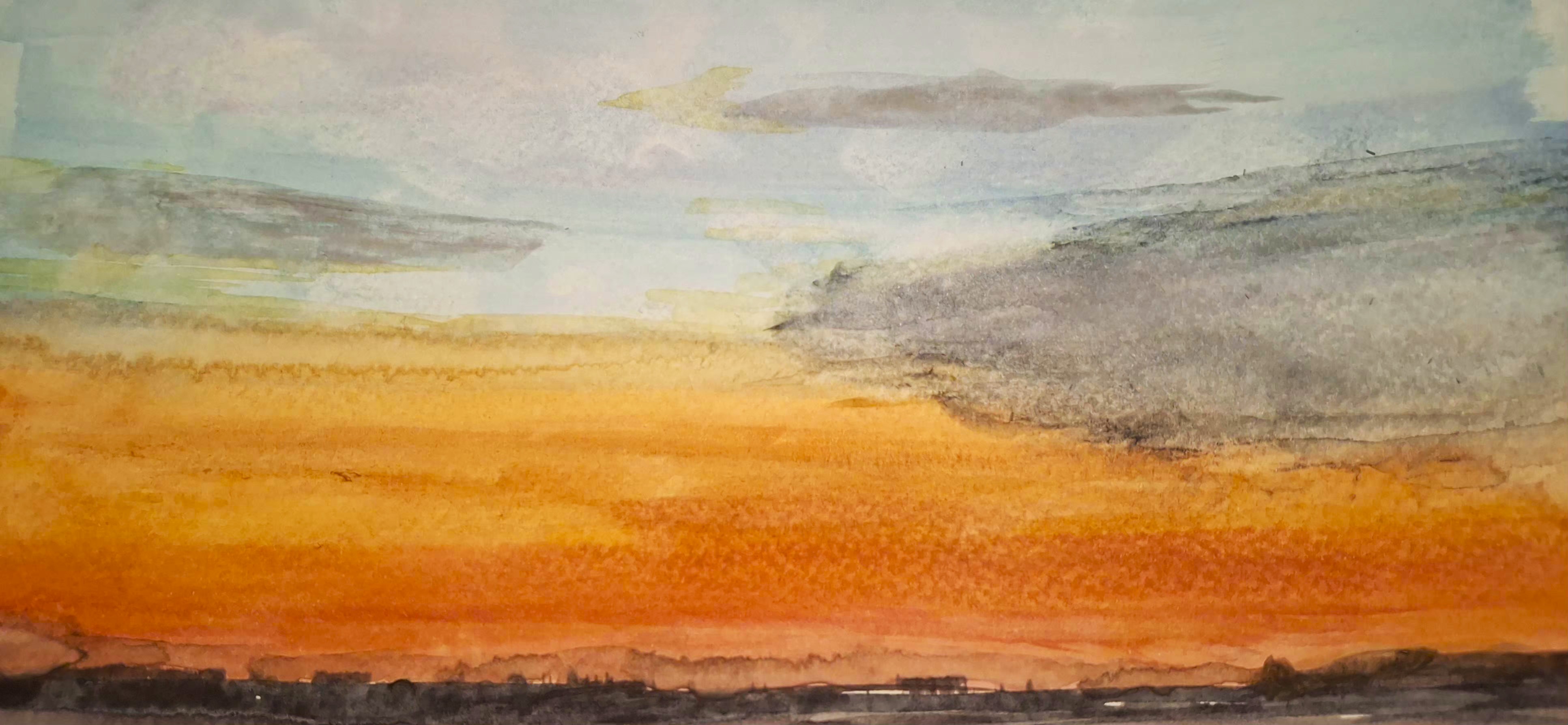
Colin White - ‘When I Look to the West’
Our project volunteer, Colin White, sent this beautiful watercolour he did of his 1981 view from 99 Prospecthill Circus. He said:
The words to the Led Zeppelin song Stairway to Heaven used to come to my mind when I was looking out the window. 'There's this feeling I get, when I look to the west, and my spirit is crying for leaving '. Honestly! Sounds like something out of Wayne's Word, but true!
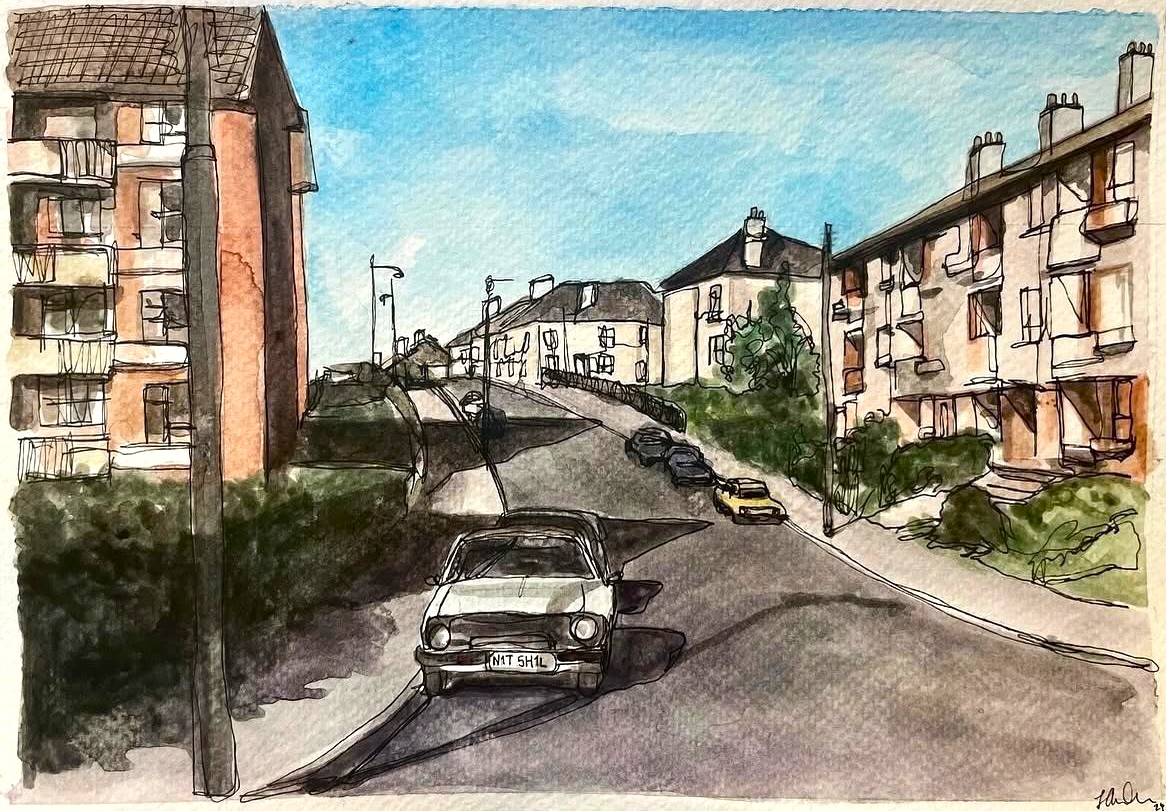
Jodie Anderson - 'Pinmore Street in Nitshill'
I came across a photo via social media, and now cannot for the life of me find who uploaded it or where it was uploaded.
The street is Pinmore Street in Nitshill.
It interested me because I know about the Nitshill Memories project, actually my dad has the book and loves it, as he was born and brought up in Nitshill, the same as his own father.
Contact: JodieAndersonart on Facebook.
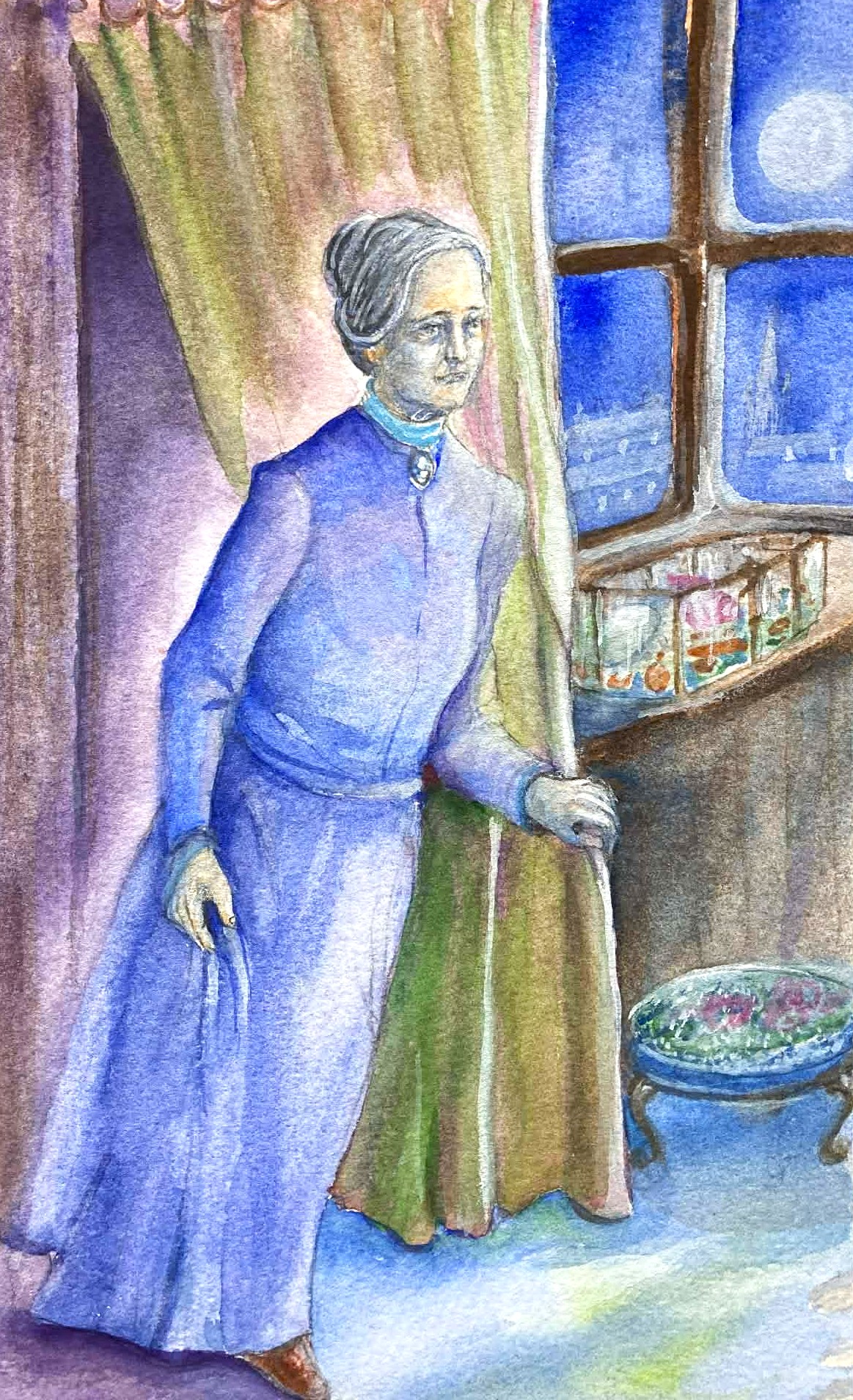
Joyce Kelly - ‘188 St George’s Road, Glasgow’
My 2x great grand aunt, Mary Thomson Runciman, had a grandson who was a Church of Scotland minister in Greenock - Rev James T Runciman; he wrote poetry in secret to unwind. Mary had around 7 kids and lived at 188 St George’s Rd, Glasgow, from the 1890s until she died in 1931. There is a written account of three of her adult children seeing Mary’s ghostly presence on the evening of the day she died, and at least one was a Church of Scotland minister. This resulted in a poem, ‘188 St George’s Street, Glasgow’ (which can be read in the Creative Writing section of this website).
My third cousin once removed, Alan, who is Mary’s great grandson, has put the poem together with my Mum’s illustration, to be passed down his family; both are in the family’s archive.
This is my late Mum’s representation of her great grand aunt’s apparition. It’s a wonderful portal into the past.”
In memory of the wonderful Joyce Kelly, Artist in Residence at Communities Past & Futures Society
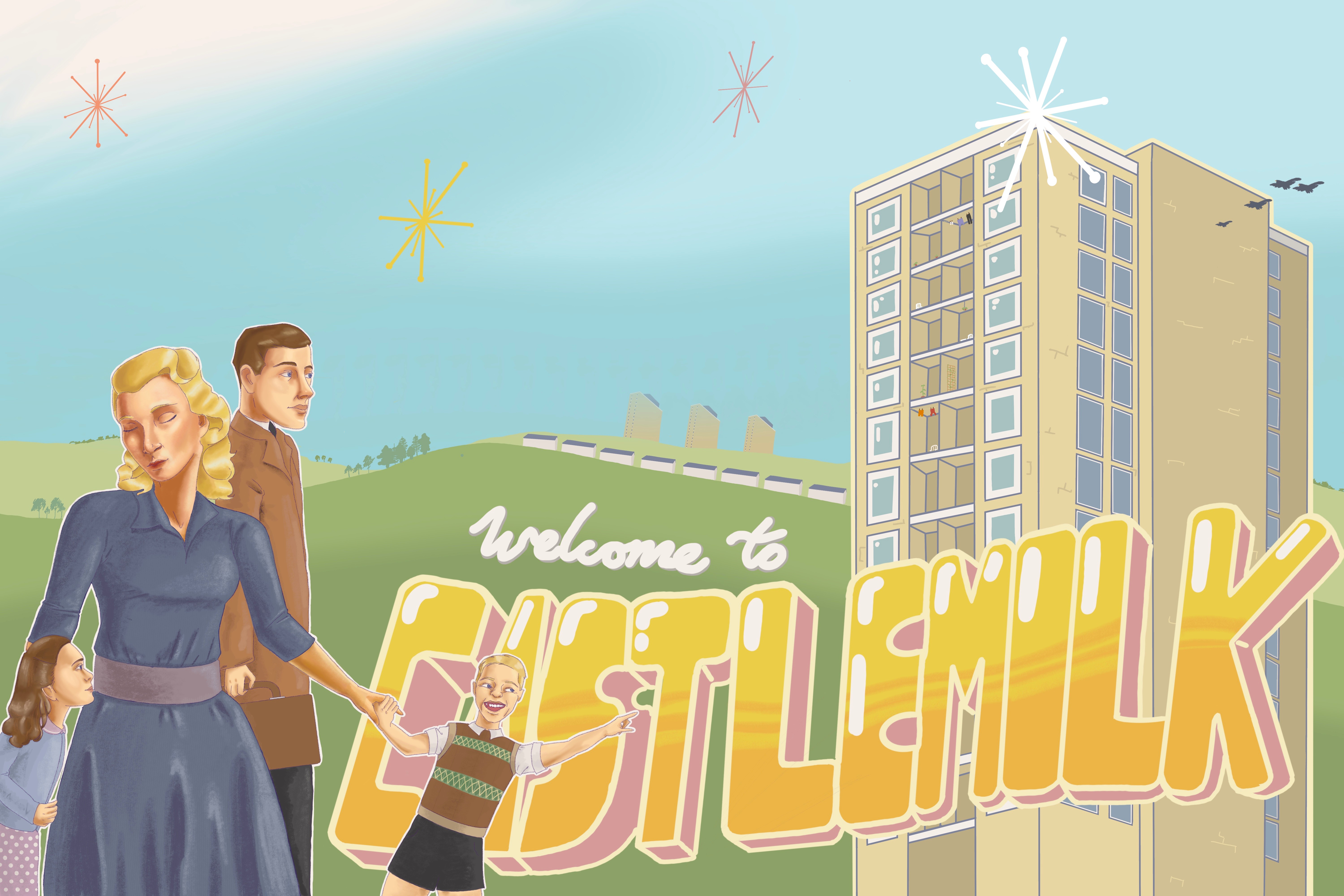
Murray Crosbie - ‘Welcome to Castlemilk’
It is very much an amalgamation of many ideas. I feel it's a mix of both being a postcard, like being on holiday, as these new flats would be so new and exciting for the working class, and also like an obvious advertisement, as during the 1950s and 1960s there was such an increase in consumerism. In saying that, of course this was more prevalent in middle- and upper-class families. However, it helps entice lower class families with the idea they were moving into a more wealthy, prosperous future.
In keeping with the time, this is why I chose a usual depiction of families from the 1950s, clothing and all; the children, of course, excited, and beady-eyed having a new home, the father walking proudly as he gives his family a new and better chance at life. However, for the mother, I had her look away to evoke the idea that not all would be perfect, as would soon be found by many families.
In terms of the background, I chose to have other flats rather far away, to express how far away new housing was built, and also how some lower-class families were pushed far from the rest of Glasgow.
Murray Crosbie - ‘Late 1950s Tenements’
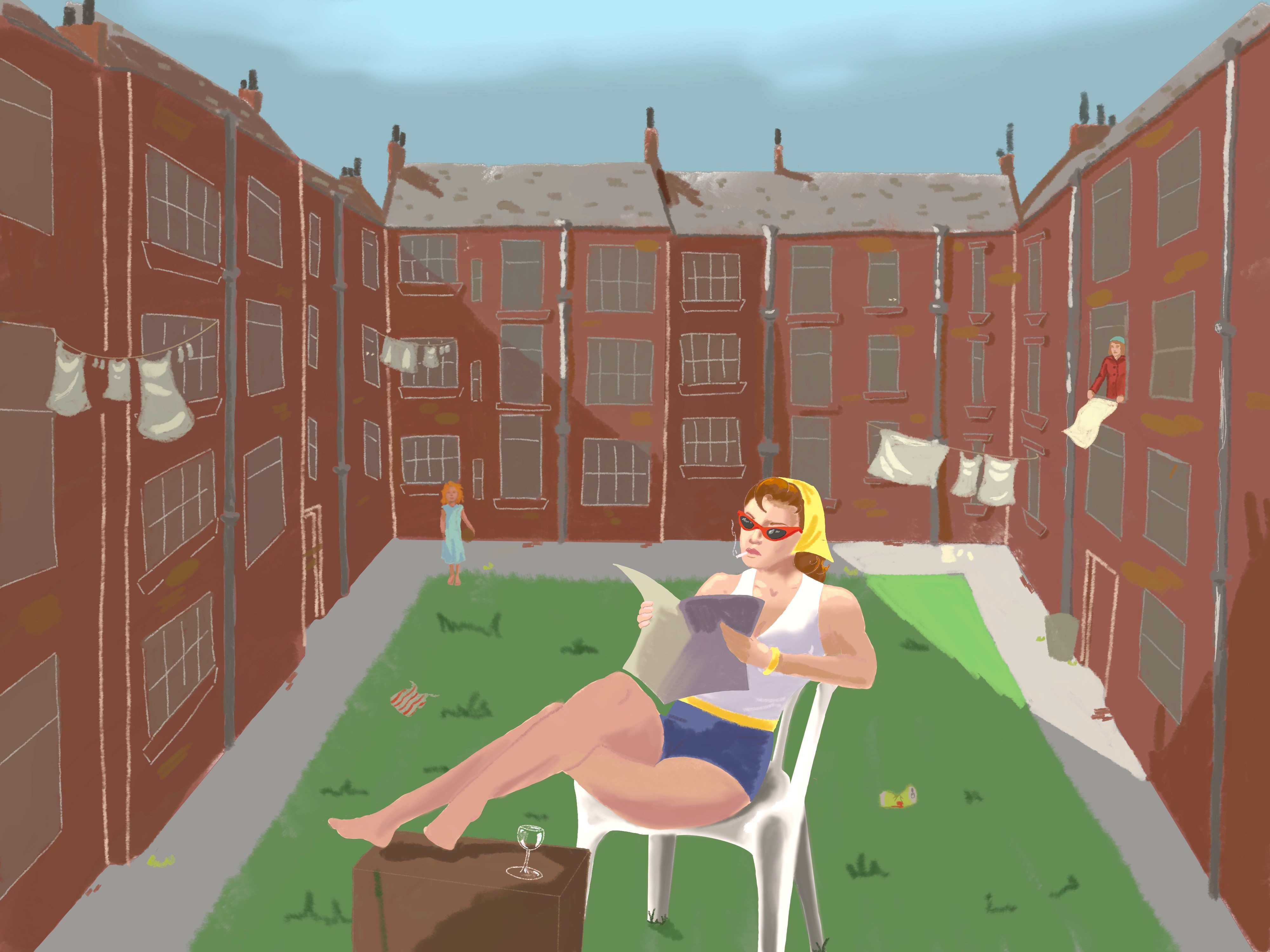
My choices this time were to show how, by the second half of the 20th century, many tenements were being demolished. I wanted it to again give the idea that these new high-rise flats were the way of the future.
I chose to have the woman in the centre and have the tenements rather tall to create the dark, enclosed court. It's to make her feel imprisoned, as the lower class populous would probably never escape this. I also chose this to show the lack of privacy you were given, and even the idea of sitting smoking a cigarette, you would be gawked at by neighbours.
Most lower-class tenements were not well kept and so I had debris scattered about, along with varying pieces of rubbish. The use of many pieces of clothing being dried also, once again, relays back to the lack of space many of these homes would have.
I hope this helps convey my idea for the piece.