Glasgow Housing, 1830-1914
by Morven Mackenzie
Throughout the Victorian era, Glasgow rapidly expanded into an industrial metropolis, so-called the ‘Second City of the British Empire’. With Glasgow’s newly emerging industries - shipbuilding, engineering works, and textile factories - workers flocked to the city in search of steady jobs, and the population increased from around 100,000 in 1811 to over one million by 1911.i Rapid industrialisation and population growth had a huge impact on housing in Glasgow, which over the Victorian and Edwardian eras was characterised by chronic poor conditions and poor public health.
Conditions
Most migrants arrived in Glasgow from the Highlands or Ireland seeking unskilled and low paid work, and tended to find housing in the cheapest areas, nearby industrial workplaces. The medieval Glasgow Cross (the area surrounding High Street, Saltmarket, Trongate, and Bridgegate) became notorious for slum housing. By the 1860s, the old town housed more than a thousand people per acre, some 75,000 people.
In the eighteenth century, the old town was home to wealthy merchants and businesses.ii However, by the Victorian era it was unrecognisable as landlords exploited the needs of desperate immigrants, turning multi-story townhouses into multiple single-room apartments, quickly constructing shoddy tenements into the former gardens between them.iii As the city centre fell into dilapidation wealthier families moved further afield to the west end and the southside.
Tenement buildings provided an affordable and fast solution to housing the growing population and enabled expansion of neighbourhoods like Finnieston and Dennistoun. Tenements were mostly constructed between 1850 and 1900 but between 1872 and 1876 21,000 tenement flats were constructed in Glasgow.iv Typically, tenements were made up of multiple storeys, and in working-class areas, had several houses of one (single-ends) or two rooms (room-and-kitchens) on each floor; these tended to be centred around back court, with communal toilets, washhouses, and midden heaps (a dump for domestic waste). However, people from all classes resided in tenements - ranging from tiny single-ends to much larger and more elaborate apartments.
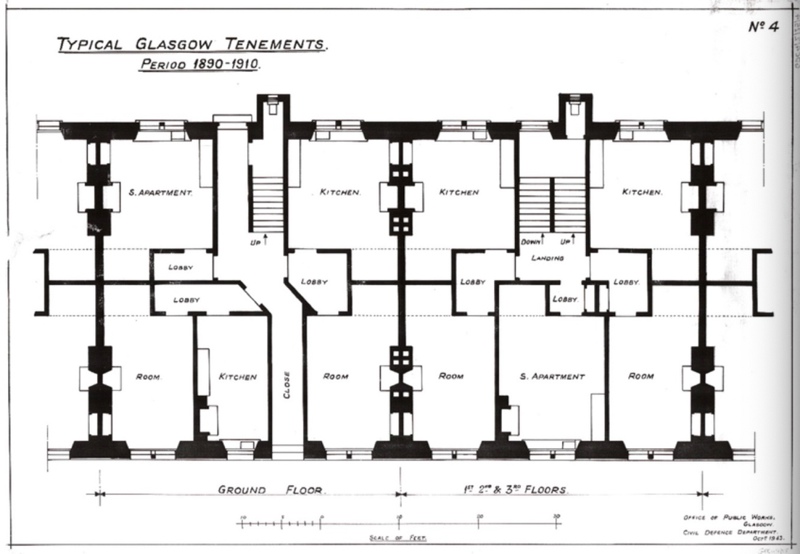
This image shows the typical layout of working-class Glasgow tenements at the turn of the twentieth century; single-ends sandwiched between two room-and-kitchens.v In addition, bed recesses can be seen maximising the unused space between the lobby and the outer wall. A bed recess was essentially a hole-in-the-wall and was typically covered by a curtain and had storage space under the bed - often for another folding bed.
Life in a tenement was completely communal, with entire families living in one or two rooms. And, as such, tenements directly contributed to overcrowding. Glasgow was the most overcrowded city in Britain. According to the 1911 Census, 104,641 individuals or 13.8 per cent of the population lived in houses of one room; and 367,341 or 48.4 per cent of the population lived in houses of two rooms.vi
A newspaper article from 1842 describes Glasgow’s overcrowding and housing conditions as:
Endless labyrinths of lanes or wynds into which open at almost every step, courts or blind alleys, formed by ill-ventilated, high-piled, waterless, and dilapidated houses. These are literally swarming with inhabitants. They contain three or four families upon each floor, perhaps twenty persons.
This extract emphasises the extent of overcrowding and deprivation of slum housing in Glasgow.
In turn, overcrowding caused an utter lack of sanitation and caused widespread disease and high rates of infant mortality. For instance, in 1888 infant mortality rates were recorded at 32 per cent of infant deaths younger than five were in one-roomed houses, compared to 2 per cent in houses of over five rooms.viii
It was working-class women who experienced the worst of poor conditions in Glasgow tenements, the tenement was the centre of their lives; their childhood playground, where they found husbands and married, gave birth and raised families, cared for elderly relatives, and eventually faced old age and death.ix The prevalent Victorian ideology of separate spheres ensured a sexual division of labour. Working-class men entered the ‘public sphere’ through industrial manual labour as the sole earner for the family, while women remained housewives in the ‘domestic sphere’ and were responsible for housework and childrearing.
Mothers, on an already tight budget, had to raise large families in one or two roomed houses. With constant packing away of make-shift beds and converting furniture from sleeping to sitting space during the day.
The mother tries to make up a separate bed for the boys, and this bed has to be made down on chairs, etc., every night and packed up and tucked away with no chance of airing every morning. All this makeshift entails a very great deal of extra labour…
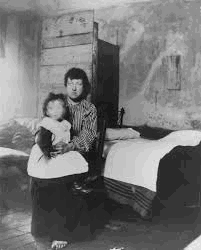
Interior of slum tenement house, c. 1910. Glasgow City Archives, Ref: P662.
It was an endless effort to keep small tenement houses clean and organised. Before domestic technologies, daily chores were considerably more time-consuming and labour intensive. For example, wash houses were most often on the ground floor of the tenement buildings, and women had to carry heavy baskets of laundry up and down the close; those who lived on top floors could have as much as sixty steps to climb.xi Despite the harsh conditions, working-class women took great pride in keeping up appearances, ensuring tenement houses, closes, and communal toilets, were always kept spotless.xii
The inherent communal nature of tenements enabled women to form close relationships with their neighbours as networks of support. Personal testimonies often recall the neighbourliness and sense of community within tenements, with fond memories of neighbours stopping in the close for a chat or coming round for cups of tea.xiii Equally prevalent is the sense of loss for community as tenements were condemned and cleared, and families moved from their homes throughout the twentieth century.xiv
Improvement
The conditions of working-class housing in Glasgow spurred Victorian moral concern, and some effort was made into improvement. This was mostly as a response to chronic illness and disease, dark and damp housing caused typhus and unclean water supplies caused outbreaks of cholera throughout the Victorian period, which affected wealthy and poorer populations alike. With no plumbing or safe water supply, it was safer for Glasgow’s population to drink beer, even children drank a weak ale known as ‘small beer’. In turn, facilitating a culture of alcoholism; in 1866 it was noted, ‘the immense masses of population have no resource but a spirit shop at every fifty yards…’.xv
Polluted water from public wells, supplied by the Clyde, and local burns were recognised for the spread of ill health, and, in 1859, the new municipal water scheme from Loch Katrine was opened.xvi It was a massive feat of public works and engineering to transport the water some 35 miles to Glasgow, requiring the construction of dam and 26 miles of aqueduct.xvii The Loch Katrine water scheme saw a sharp decrease in the spread of chronic disease.
In 1866 further improvements were implemented; firstly, The Glasgow Police Act introduced ‘ticketing’, which sought to control the number of occupants permitted to sleep within smaller houses. In theory, this Act should have reduced overcrowding, however, a shortage of cheap housing meant landlord and tenants found workarounds, with many paying lower rent to sleep on the floors of ticketed houses.xviii The Police Act was more effective in controls over new construction, non-public buildings could only be built to a height equal to the width of the street, which led to the sprawl of four-storey tenements we recognise today.xix
Similarly, in 1866, the City Improvement Trust was established under the City of Glasgow Improvements Act of the same year, which granted the city permission to buy and demolish slum houses in the neighbourhoods of the old city centre and build new tenements to a higher standard.
Immediately the Trust began to demolish slums in the old town, but it took longer than expected as landlords were expensive to buy out. This meant there were not enough funds for housebuilding, and between 1866 and 1876, 28,965 of Glasgow’s population, or 6.06% were displaced by slum clearing, which consequently put increased pressure on surrounding neighbourhoods - that of Calton and Gorbals.xx The Trust did construct some new tenement buildings with houses of at least two rooms, running water, and an inside toilet.xxi However, the high standard meant higher rent, further exacerbating the displacement of those who had lived in the neighbourhood.
Significantly, before demolition began, the Trust commissioned photographer, Thomas Annan, to document condemned streets and wynds. His series of photographs are understood to be amongst the first records of slum housing in photography, and reveal the extent of overcrowding, with buildings shoddily crammed on top of each other.
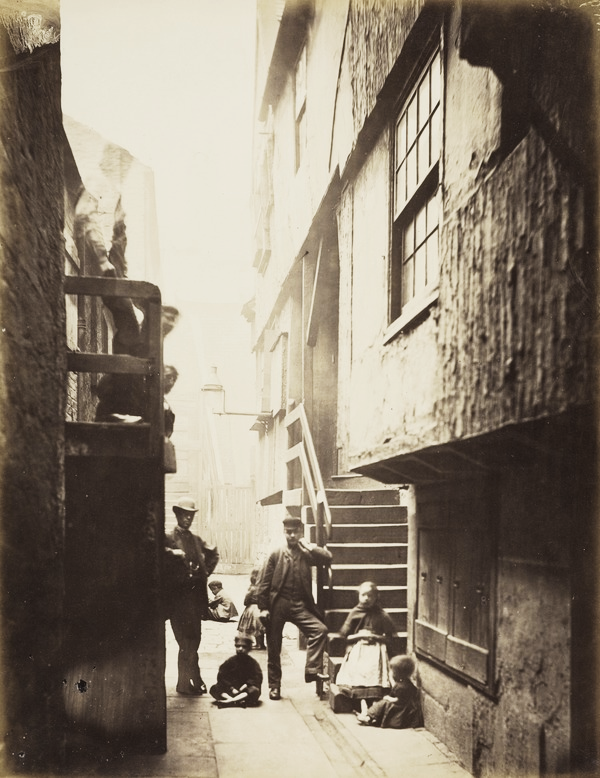
Thoman Annan, Close, No. 28 Saltmarket, 1868-1871xxii
This photograph not only gives insight into the harsh conditions of Glasgow’s slum housing, with tight alleyways and little sunlight. But the presence of the children and young men is revealing of Glasgow’s slum population. The communities of working-class migrants that resided here were perceived with prejudice from middle and upper-class observers; according to an 1842 newspaper article ‘the poorest, most depraved, and worthless members of the community.’xxiii However, this photograph returns agency to the working-class population who stand proudly and defiantly in front of the camera.
Ultimately, attempts for improvement throughout the Victorian era proved largely unsuccessful and, in fact, worsened overcrowding as new construction did not keep up with slum clearance and the rent too high for many working-class families.xxiv Nevertheless, the Glasgow City Improvement Trust set precedent for municipal intervention and slum clearance, inspiring other cities, such as London, and paving the way for future improvements and developments in Glasgow throughout the twentieth century.
Bibliography
Primary
Engels, Friedrich, The Condition of the Working-Class in England, (Cambridge: Cambridge University Press, 2010).
Russell, James B., Life in One Room, (1888).
Royal Commission on the Housing of the Industrial Population of Scotland, Rural and Urban, (1917).
Interior of slum tenement house, c. 1910, Glasgow City Archives, Ref: P662.
Secondary
Clark, Helen, and Elizabeth Carnegie, She Was Aye Workin’: Memories of Tenement Women in Edinburgh and Glasgow, (Oxford: White Cockade Publishing, 2003).
Gossman, Lionel, Thomas Annan of Glasgow: Pioneer of the Documentary Photography, (Open Book Publishers: Cambridge, 2015).
Millar, Michael-Allan, et al, ‘An Investigation into the Limitations of Low Temperature District Heating on Traditional Tenement Buildings in Scotland’, in Energies, 12 (13) (2019).
Withey, Matthew, The Glasgow City Improvement Trust: An Analysis of its Genesis, Impact and Legacy and an Inventory of its Buildings, 1866-1910, (Unpublished Doctoral Thesis, University of Saint Andrews, 2003).
Fraser, W. Hamish, ‘Second City of The Empire: 1830s to 1914’, The Glasgow Story, available at: https://www.theglasgowstory.com/story/?id=TGSD0.
Glasgow Life, ‘Glasgow City Improvement Trust – Times Past’, (2022), available at:
Lee, Christopher, C., ‘Everyday Life: The Home’, The Glasgow Story, available at:
https://www.theglasgowstory.com/story/?id=TGSDA04.
McGrath, Roberta, ‘Thomas Annan’, National Galleries of Scotland, available at:
https://www.nationalgalleries.org/art-and-artists/features/thomas-annan
McKean, Charles, ‘Buildings and Cityscape: Tenements’, The Glasgow Story, available at:
https://www.theglasgowstory.com/story/?id=TGSDF10.
Nenadic, Stana, ‘Everyday Life’, The Glasgow Story, available at:
https://www.theglasgowstory.com/story/?id=TGSDA
RCAMS and Jelle Muylle, ‘Glasgow Corporation Water Works and Loch Katrine Scheme: Survey Report’, (Historic Environment Scotland, 2007), available at:
https://lochkatrineaqueduct.co.uk/documents/jm_history.pdf.
---
[i] L. Gossman, Thomas Annan of Glasgow: Pioneer of the Documentary Photography, (Open Book Publishers: Cambridge, 2015), p. 89.
[ii] Ibid.
[iii] Ibid.
[iv] C. McKean, ‘Buildings and Cityscape: Tenements’, The Glasgow Story, available at: https://www.theglasgowstory.com/story/?id=TGSDF10.
[v] M. Millar et al, ‘An Investigation into the Limitations of Low Temperature District Heating on Traditional Tenement Buildings in Scotland’, Energies, (2019), p. 5.
[vi] 1911 Census referenced in 1917 Royal Commission on Housing, p. 104.
[vii] Friedrich Engels, The Condition of the Working-Class in England, (Cambridge: Cambridge University Press, 2010), p. 37.
[viii] J.B. Russell, Life in One Room, 27 February 1888, p. 11.
[ix] Clark and Carnegie, She Was Aye Workin’: Memories of Tenement Women in Edinburgh and Glasgow, (Oxford: White Cockade Publishing: 2003), p. 13.
[x] 1917 Royal Commission on the Housing, p. 91
[xi] Ibid., p. 64.
[xii] C.C. Lee, ‘Everyday Life: The Home’, The Glasgow Story, available at: https://www.theglasgowstory.com/story/?id=TGSDA04
[xiii] Clark and Carnegie, She Was Aye Workin’, pp. 124-126.
[xiv] Ibid.
[xv] M. Withey ‘The Glasgow City Improvement Trust’, (Unpublished Doctoral Thesis, University of St Andrews, 2003), p. 14.
[xvi] W.H. Fraser, ‘Second City of The Empire: 1830s to 1914’, The Glasgow Story, available at: https://www.theglasgowstory.com/story/?id=TGSD0
[xvii] RCAMS and J. Muylle, ‘Glasgow Corporation Water Works and Loch Katrine Scheme: Survey Report’, (Historic Environment Scotland, 2007), p. 3.
[xviii] Withey, ‘Improvement Trust’, p. 10
[xix] Ibid., p. 11
[xx] Sean Damer, Glasgow: Going for a song, (London: Lawrence & Wishart, 1990), p. 80.
[xxi] Glasgow Life, ‘Glasgow City Improvement Trust – Times Past’, (2022), available at: https://www.glasgowlife.org.uk/libraries/family-history/stories-and-blogs-from-the-mitchell/times-past-blogs/glasgow-city-improvement-trust-times-past
[xxii] R. McGrath for National Galleries of Scotland, ‘Thomas Annan’, available at: https://www.nationalgalleries.org/art-and-artists/features/thomas-annan
[xxiii] Engels, Condition of the Working-Class, p. 37.
[xxiv] S. Nenadic, ‘Everyday Life’, The Glasgow Story, available at: https://www.theglasgowstory.com/story/?id=TGSDA