History of Neighbourhoods and Housing in Glasgow 1950s-2000 – Inner City Changes
by Lani Heywood
1950 marked Glasgow’s population peak at 1.089 million. The city had grown exponentially throughout the 19th century, due to immigration from the Highlands and Irelands and by 1945, one in seven in the Scottish population lived in the same three-square miles of Glasgow’s city centre. The tenement housing that dominated the city was poor quality, dirty and overcrowded with most families living together in a singular room and sharing an outdoor WC with the entire block. As a result of poor housing, infant deaths were common, the morality rate for tuberculosis was the highest in Europe and the city had got itself a grim reputation. Although the city’s overcrowding crisis had been desperate since the turn of the century, the second world war had delayed progress, so much so that by 1950, approximately 80,000 new homes were necessary to relocate people living in slums across the city, and the race was on to shape Glasgow up and move into a brighter future.
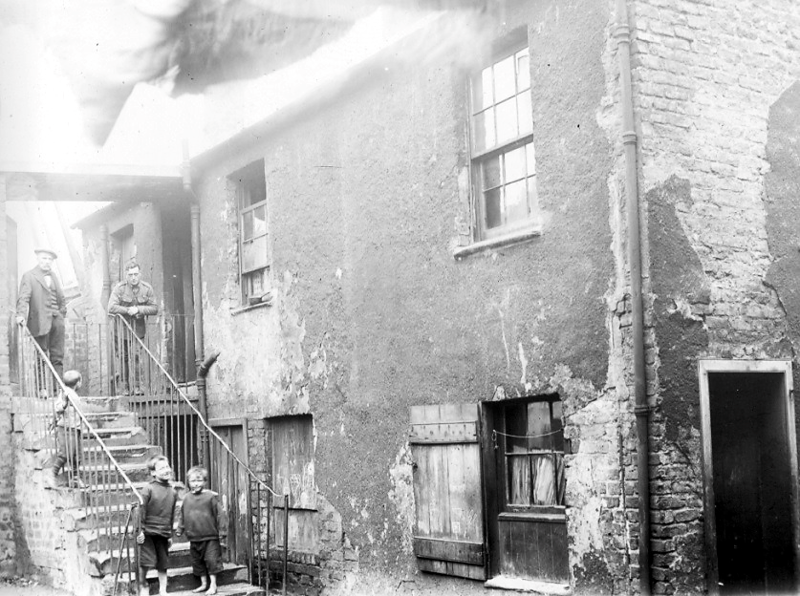
2 Thomsons La, Calton, c.1920 Archive Ref-p9107
In 1945, Master of Works and City Engineer for Glasgow Corporation, Robert Bruce, put forward his vision for a ‘healthy and beautiful’ Glasgow, one far removed from the grimy reality of the city post-war. The initial ‘Bruce plan’ suggested that the majority of Glasgow be ripped down and rebuilt, focusing on an overhaul of the inner city to make way for a new ring road. The City Hall, Royal Infirmary, Mitchell Library, and ‘blighted’ slums were to be destroyed and replaced with garden suburbs and modernist tower blocks. Bruce wanted to wipe the slate clean and start again – a dream that proved to be impractical and rash. Although some proposals from his report were put into action as Kinning Park, Cowcaddens, Anderston and Townhead were all cleared to make way for the construction of the ring road (the M8), the reports’ plans were revaluated upon the arrival of the Clyde Valley Regional plan (CVP) in 1946.
The CVP plan proposed that the inner-city residents be housed in new ‘overspill’ towns and large peripheral estates that would be constructed in line with the clearance and relocation of slum residents. The plan seemed more practical than the Bruce Report’s call for destruction - allowing the city centre’s historical buildings to be saved and for residents to be housed quicker, without the wait for inner city neighbourhoods to be cleared and rebuilt.
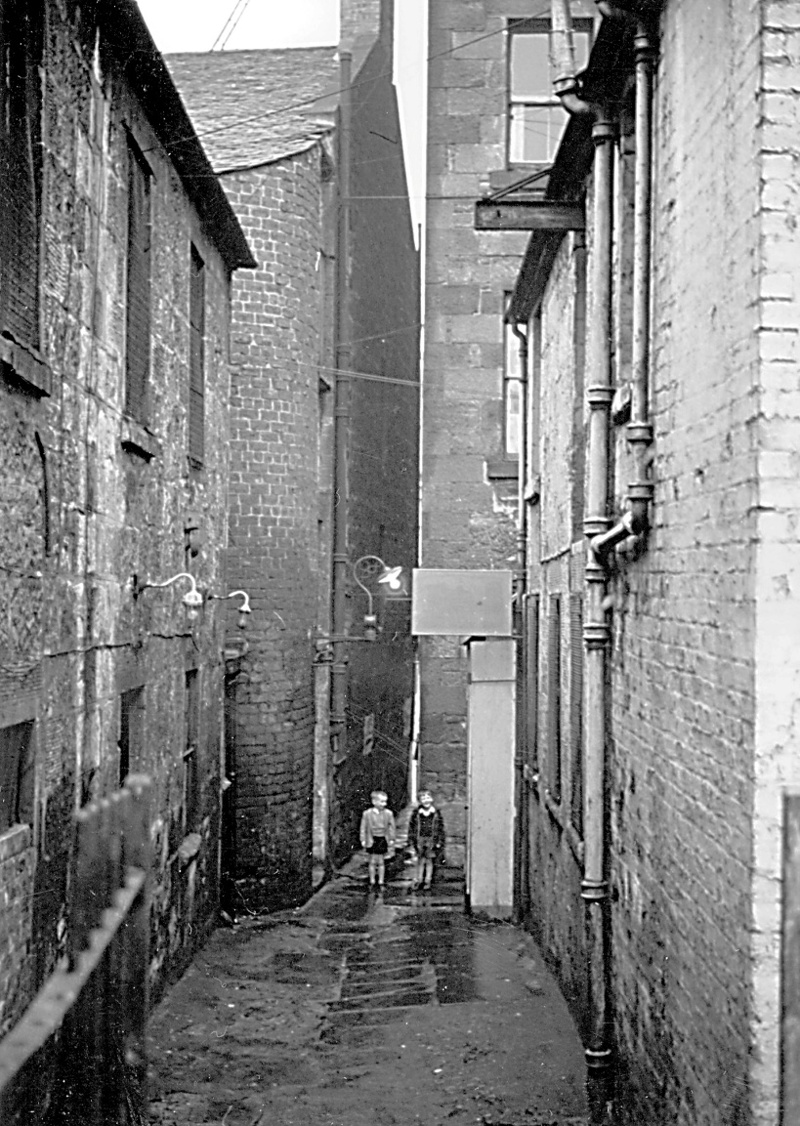
163-165 Cowcaddens St, 1963
However, Glasgow continued to lack space. As a large proportion of land on the outskirts of the city was protected from development under the ‘green belt’ policy, the steep Campsies were impractical for construction and the land surrounding Glasgow from the east was too boggy – attention was turned back to the inner city and the Bruce Report. Midway through the 1950s, a new report was published calling for the redevelopment of inner-city areas earmarked as CDAs.
Comprehensive Development Areas (CDAs) were identified in the inner city for clearance and redevelopment. The 29 CDAs were slums neighbourhoods that Bruce’s report referred to as ‘blighted’ – unsightly urban areas - such as the Gorbals and Hutchesontown, Springburn, Glasgow Cross, Partick, and Maryhill. The identification of these slum areas as CDA’s gave the council the power to commence the ‘Glasgow Clearances’, moving whole communities out of the tight-knit city centre and into the new schemes that were being rapidly constructed. 100,000 dwellings were to be cleared and 60% of the residents rehoused. The inner-city population plummeted and by 1974, what had been described as ‘a press of human beings more closely packed together than in any other city in Europe’, had lost approximately 310,000 people.
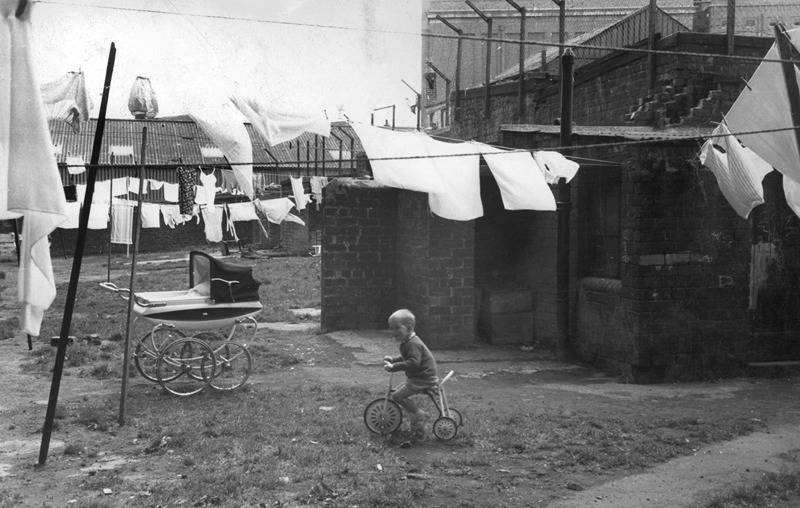
Child riding his tricycle in a back court in Partick, c.1969.
Communities that had been living in such proximity for generations were scattered across the city and surrounding areas. But not everyone left, and, for those who remained, the arrival of the high rise allowed the Glasgow Corporation to rehouse thousands of displaced residents within the inner city by building up. Sky-high living seemed like the perfect solution for Glasgow, permitting them to house the remainder of the 250,000-300,000 slum residents quickly, efficiently and with the little space afforded to them.
Like all the residents rehoused into council accommodation during this post-war housing boom, the high-rise occupants were promised modernity, comfort and ultimately – a new start. One in which their family would live in more than two rooms, have their own toilet, and maybe even TV.
In 1957, five renowned architects were commissioned to each design a zone of the Gorbals - one of the city’s most derelict neighbourhoods. Brutalist architect Sir Basil Spence designed Hutchesontown C Zone, constructing three 20-storey towers that contained 400 homes and were connected by outdoor walkways. Spense envisioned the ‘Hutchie C’ as a Spanish galleon pioneering through Glasgow’s skyline. Looking like ‘ship in full sail on wash day’, the block was complete with balconies which earned it the affectionate name of ‘the hanging gardens of the Gorbals’. Many residents recall their excitement at the availability of hot water, their own toilet, and the space to spread out further than one or two rooms. In many ways, a strong sense of community was rebuilt.
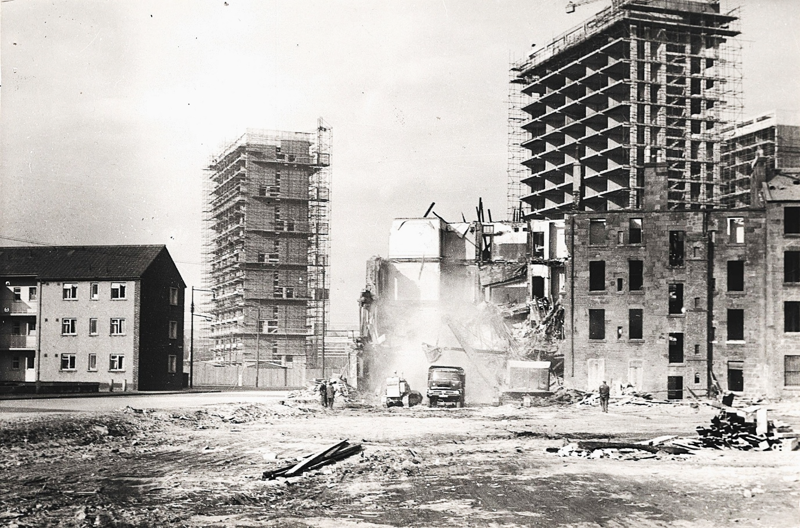
Allison's did much of the demolition of the Gorbals.
Glasgow’s embrace of the high rise signified a move towards optimism and a display of strength and resilience. Eager to wipe the slate clean, the city wanted to forge a new life for itself and its residents. The corporation commenced inner-city construction with gusto, and, by the mid-1970s the council and Scottish housing owned 321 high-rise blocks. Glasgow’s skyline was transformed and the towers reaching up from across the city served as a reminder of its post-war metamorphosis. However, during the 1960s, the social and structural realities of their rapid construction came under fire.
The cost of maintenance and repair of these new high rises was increasing with fresh reports showing that over six million houses needed repairs and one million of them, demolition. The high rise also began to be regarded as an unhealthy environment for the development of children, mothers, and vulnerable individuals. Living on top of each other with little shared space meant that community wasn’t always easily created or maintained. It could also be argued that the large-scale displacement of long-standing communities caused by the clearances was additionally to blame. However, for the kids who grew up there, their testimony doesn’t seem to reflect these dour reports. They mostly recollect enjoyment of the same kind of freedom they would have had living in the tenements. Many schemes had parks nearby and the children had the freedom to explore in and around their new homes. Pieces would be thrown down from half-way up and the kids would only trudge back up the flights and flights of stairs at dinner time.
The Glasgow wind, however, proved to be a strong adversary for the new builds. Modelled on flats built in the 1940s in Marseille, the block design was no match for the northern weather. In the documentary ‘High Rise and Fall’ residents living in Hutchie C talk about losing their washing over the top of the block on windy days and having to go ‘all over Glasgow looking for it’. Residents also recalled the wind at the base of the buildings knocking elderly people off their feet, and lifting dogs on leashes and kids, with make-shift parachutes, into the air.
The real issue, however, came when within months of the first few move-ins into another Gorbals and Hutcheson town high rise, Hutchie E, problems with damp were being reported. Blame was turned onto the tenants as officials from the Housing departments claimed that the residents' lifestyles were responsible for the rampant mould, however, it was the blocks poor design that should have been charged. Nevertheless, with 60 percent of the councils’ funds being put towards the repayment of loans taken out during the post-war boom, it seemed that yet again, they were unable to afford the upkeep on their own housing. 10 years after their completion, by 1982, 60 percent of flats in Hutchie E were affected by damp and many of the residents had occupants had cleared out already. After being promised a new start, ‘The Dampies’ were devastating. Walls, carpets, and furniture slowly were slowly destroyed by black mould and some residents experienced health issues. The remaining residents called to be rehoused and compensated, enacting a rent strike between 1975 and 1981 to fight against the accusations of tenant responsibility. The Dampness Monster was defeated, and the affected blocks were pulled down in 1987, lasting only 15 years. In 1993, over 10 years later, the same fate befell Sir Basil Spense’s ship in the sky and Hutchesontown C was also demolished due to damp infestation after standing for just 30 years. The blocks were proving to be money pits and the council felt that that money would be best spent elsewhere. Again, entire communities were displaced as these blocks began to fall.
Queen Elizabeth Flats – before demolition
Many schemes also faced social problems. For those who had moved there in the 1950s and 1960s when the schemes were first built, their new homes were their chance of a fresh start and a move towards a brighter future. It was often younger families and more skilled workers who were selected to move into the new towns and peripheral estates as industry was relocated away from the inner city too. Those that remained in the city were mainly manual workers, their families, and elderly people - those considered less suitable or, perhaps, less beneficial, for the development of these new communities under the corporation’s choosy ‘overspill’ policy. Nicknamed in the papers as the ‘vertical slums of the future’, the blocks were quickly identified as undesirable, crime ridden and ‘no goof’. As council housing became residual and no longer a solution for the many, it began to be used as an ‘ambulance service’ for the vulnerable who had nowhere else to turn. There was a great effort from long standing tenants to distinguish themselves from the ‘antisocial’ newcomers.
Residents mourned the family-feel that the blocks had in the beginning, with communal cleaning, friendly neighbourly relations and general respect and care for their homes and community. Many residents who hadn’t been heavily affected by the city’s deindustrialisation begun to move out and join the property ladder, as the desire to be a ‘homeowner’ became more widespread, leaving the remaining residents within another crumbling community.
By 1981, private ownership of housing was still rare and most of Glasgow’s property remained in hands of the council after the mass purchase of CDA land post-war. Margaret Thatcher’s ‘Right to Buy’ scheme gave an opportunity for those living in council housing to buy their homes. A discount was available for those who had lived in their home for longer than 3 years and with the maximum discount at 50%, the incentive was hard to decline. As a result, housing sales continued to increase in Scotland and by 1998, 25,000 public sector houses were sold. Despite the rise in homeownership, with a large proportion of the city’s social housing stock now in the private market, the availability of affordable housing became dire. Production of dwellings in the council sector was already down by over half by the early 1980s and with the money councils received from these sales not being used to build more affordable housing, low-cost property became scarce. By the early 2000s, the increase in homeowners was very quickly becoming a rapid decline as rent and housing prices rose exponentially throughout the 1990s as a result of the mass privatisation. By 1990, the average house price was 10x the average house price in 1971.
Despite efforts to regenerate the inner city, Glasgow’s population was in decline. By 1998 the loan debt racked up by the Glasgow Corporation on post-war housing was £1.6 billion, and the generation of a new housing trust was in the works to deal with the debt and continuous need for regeneration and refurbishment. Social housing stock was nearly 46,000 homes down since 1950, and the 2001 census revealed that the inner-city population was nearly 578,000, merely half of that of 1950.
Bibiography
Abrams, L, Kearns, A, Hazley, B, & Wright, V 2020, Glasgow : High-Rise Homes, Estates and Communities in the Post-War Period, Taylor & Francis Group, Oxford. Available from: ProQuest Ebook Central. [29 January 2026].
digital.nls.uk. (n.d.). Housing Act 1980 - Essay - Back to the future: 1979-1989 - National Library Scotland. [online] Available at: https://digital.nls.uk/1980s/economics-employment/housing-act/.
ESPC. (n.d.). How Scottish house prices have changed in the past 50 years. [online] Available at: https://espc.com/news/post/how-scottish-house-prices-have-changed-in-the-past-50-years
Gerry Hassan - writing, research, policy and ideas. (2019). The Rise, Fall and Rise Again of Council Housing across Scotland and the UK. [online] Available at: https://gerryhassan.com/blog/the-rise-fall-and-rise-again-of-council-housing-across-scotland-and-the-uk/.
Glasgow Life. (2022). Comprehensive Development Areas - Times Past. [online] Available at: https://www.glasgowlife.org.uk/libraries/family-history/stories-and-blogs-from-the-mitchell/times-past-blogs/comprehensive-development-areas-times-past.
Glasgowtenantsarchive.com. (2026). Glasgow Housing Struggle Archive. [online] Available at: https://glasgowtenantsarchive.com/ [Accessed 29 Jan. 2026].
McLean, D. (2022). The notoriously dire Gorbals flats that locals dubbed ‘The Dampies’. [online] Glasgow Live. Available at: https://www.glasgowlive.co.uk/news/history/notoriously-dire-gorbals-flats-locals-23683548 [Accessed 29 Jan. 2026].
Pacione, M. (2021). Glasgow. Routledge. doi:https://doi.org/10.4324/9781315681665.
Wannop, U. (1990). The Glasgow Eastern Area Renewal (GEAR) Project: A Perspective on the Management of Urban Regeneration. The Town Planning Review, [online] 61(4), pp.455–474. Available at: https://www.jstor.org/stable/40112952.
Warwick.ac.uk. (2026). Overspill Policy and the Glasgow Slum Clearance Project in the Twentieth Century: From One Nightmare to Another? [online] Available at: https://warwick.ac.uk/archive/iatl/sandbox/reinvention-copy/issues/volume1issue1/paice/ [Accessed 29 Jan. 2026].
www.gla.ac.uk. (n.d.). University of Glasgow - Schools - School of Humanities | Sgoil nan Daonnachdan - Research in the School of Humanities - History Research - Research Projects - Housing, Everyday Life & Wellbeing over the long term - Case study: Hutchesontown. [online] Available at: