The Story of Glasgow’s Public Housing Boom
by Katie Wishart
Glasgow embarked on a large-scale post-war housing program, including high-rise developments and peripheral estates, which made Glasgow City Council the largest public sector landlord in Western Europe by the 1980s.
This paper will explore Glasgow’s post war public housing boom as it occurred over time. The paper will firstly cover in brief both prewar and inter war housing to provide some context, and then explore the post war housing boom in more detail up to the end of the 1970s before a period of decline set from the 1980s onwards.
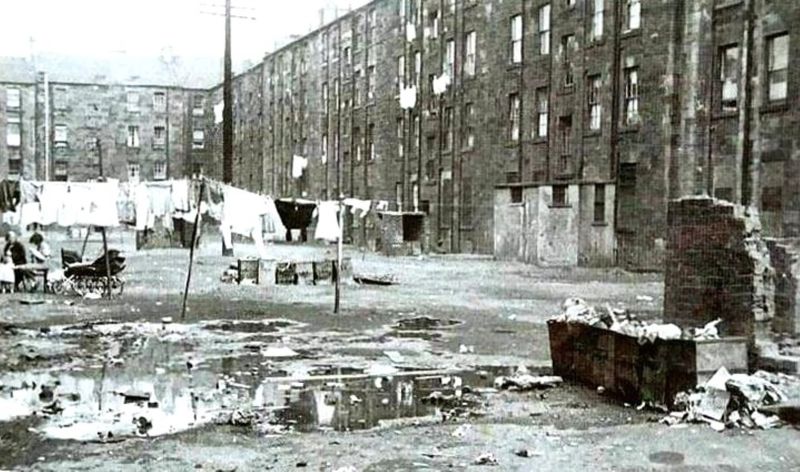
Auld Gorbals backcourt. Courtesy of John Macgregor
Prewar years
By the end of the 19th century Glasgow became known as the ‘Second City of the Empire’, with a boom in many industries such as shipbuilding, engineering, chemicals, textile and coal industries taking place. The extent of the boom is illustrated by the fact that during this period the city produced more than half Britain’s tonnage of shipping and a quarter of all locomotives in the world.
Glasgow’s rapid industrialisation induced a simultaneous influx of labour, and the population grew from 77,385 in 1801 to 784,496 in 1901. This caused a sudden demand for housing which was met almost entirely by privately rented dwellings.
There were two peaks of private housebuilding, in the mid-1870s and the end of the 1890s. The arrival of heavy industry in rural or suburban areas adjacent to the city led to property development nearby to house this growing population (e.g. shipbuilding and marine engineering in Partick and Govan; foundries, chemical works and brickworks in Shettleston and Parkhead). Construction was largely carried out by a number of different small businesses in a fragmented and speculative way. By 1882 the Glasgow building industry comprised about 240 firms mostly of small size.
Burghs such as Govan and Patrick saw a semi-rural setting of thatched cottages and hovels replaced by imposing ashlar-faced ranges of four-storeyed tenements. Many of these buildings were constructed with red, beige, or grey sandstone often quarried locally and became the predominant housing type. For example, Messrs. P W & A Light body Senior built a series of four-storeyed working-class tenements of two apartment houses for shipyard workers in the area of George Street, Whiteinch (now Medwyn Street) to the design of a John McRae of Oran Street, Maryhill.
While these tenements provided much needed housing, they also led to overcrowding and inadequate sanitation in some areas -
- Large families were often crammed into single rooms (single ends) or small two room apartments, with little space for belongings or basic hygiene.
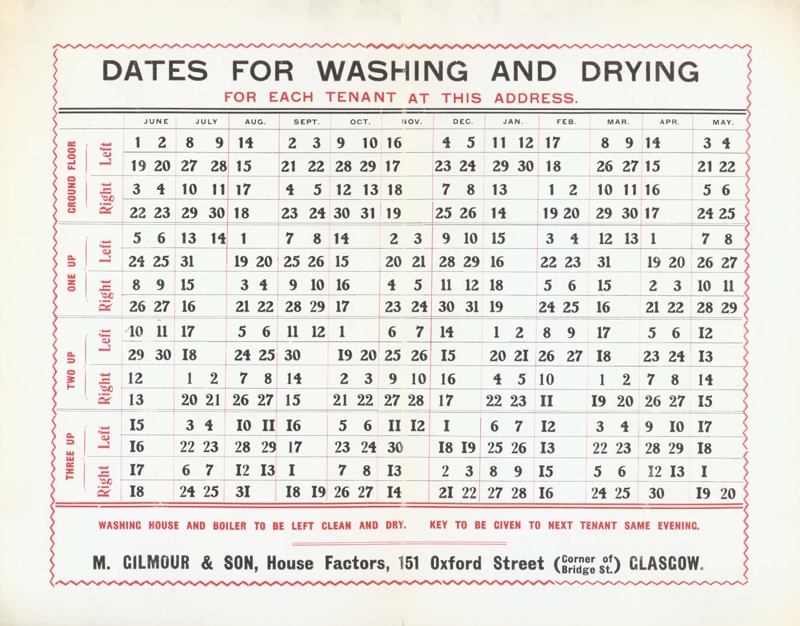
- Lack of indoor plumbing meant shared toilets and washing facilities were often located outside, sometimes in insanitary conditions.
- Overcrowding and poor sanitation contributed to the spread of diseases like cholera, typhus, and tuberculosis.
- Indoor plumbing and washing facilities were rare, and midden heaps (refuse piles) attracted rats and created foul odours.
- Conditions were such that sanitary authorities began to implement measures like ticketing houses to regulate occupancy.
By 1890 housing for the working population in the city was provided almost entirely by private landlords and speculative builders with a focus on providing affordable housing. This did not, however, necessarily translate into ‘better' housing for working people.
Interwar years
A blow was dealt to the private landlord market in 1915. The beginning of a new housing shortage and scarcity rents in a wartime context caused an outbreak of rent strikes by skilled and white-collar workers, famously led by Mary Barbour and Glasgow Women’s Housing Association.
The Government responded in kind by introducing the 1915 Rent Restriction Act, freezing rents at their pre-war level with the aim of protecting tenants from exploitation during the war. This transformed a temporary building slump into something more entrenched causing the private housing market to slump dramatically following the end of WWI.
A decision was taken to turn to local government authorities’ agencies, which had previously built only a minute proportion of housing, and stimulate them to organise a state subsidised working class housing programme, initially to relieve post war shortages.
The Addison Act, officially the Housing, Town Planning, &c. Act 1919, was the landmark piece of legislation in the UK that paved the way for large-scale council housing. The Act - (i) aimed to address the severe housing shortage following World War I by providing state-funded housing for working-class families, and (ii) authorised local authorities to build new homes and provided government subsidies to finance these projects.
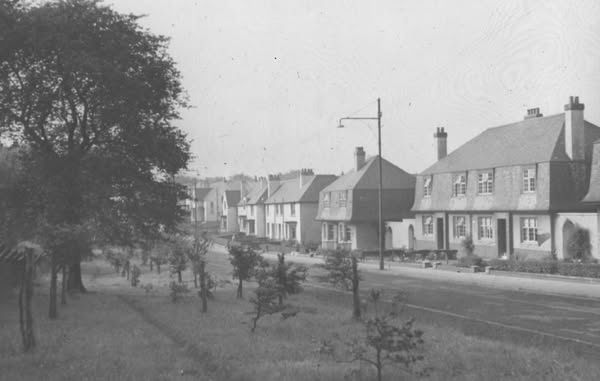
Corporation housing: pre-war housing at Damshot Rd, c.1950. Archive Ref: D-AP 9/4/31
In Glasgow this resulted in an astonishing volte face with the Corporation, having been responsible for only 1 % of pre-war houses, eventually building 71 % (54,289 dwellings) of the interwar total and subsidising a further 13%, with unsubsidised private construction accounting for a mere 12% of completions. The area of Glasgow doubled in size over the interwar years.
Lower density housing was built on the city's outskirts with most following the garden suburb model, including a large proportion of cottage flats or 'four-in-a-block' housing with separate front doors built by just a few firms. This new sprawl of housing in areas such as Balornock, Cardonald, Carntyne, Carnwadric, Croftfoot, Househillwood, Kelvindale, King's Park, Knightswood, Mosspark, Parkhouse, Riddrie and Sandyhills, were well received by the working population and many largely remain to this day.
A new approach to construction also took hold as the Corporation, from 1936, entered into the building of schemes by its own Direct Labour Organisation (DLO). This policy became firmly established in the late 1930s, with 2,000 housebuilding employees accounting for 66% of completions in 1939.
The interwar period was also marked by a major change in the architecture of Glasgow's working-class housing. In place of the ubiquitous tenement block, a two-tier system was established, with cottages on the English pattern associated with skilled and white-collar tenants, and tenements, new and old, with the less well off.
The building of new council schemes continued at speed, with substantial development during the war at Penilee, and from the late 1940s at Milton, Pollok and elsewhere, in the form of prefabricated two-storeyed cottages and, increasingly, four-storeyed tenements.
Over the years which followed the Government's ending of the private rented market in 1915, rules for local authority house building and management came into being as did the new over-riding ambition of large-scale production. The Corporation confidently believed it could rebuild and reshape the city on this basis.
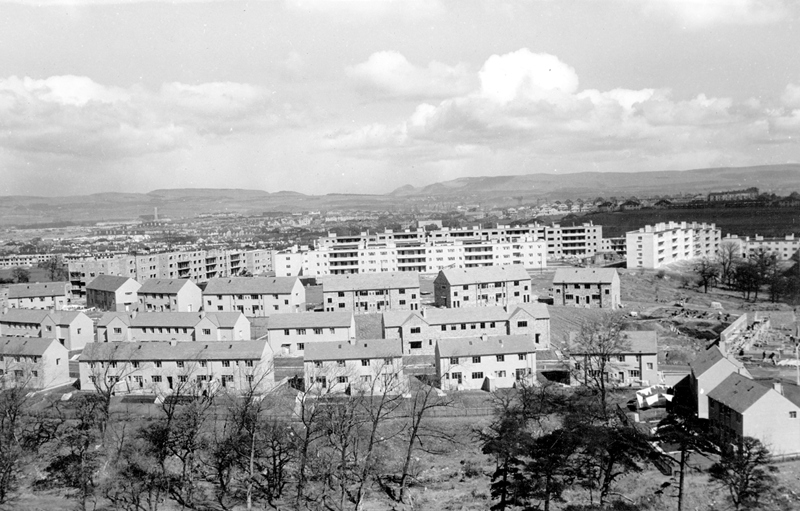
View of the Pollok housing scheme from the top of Crookston Castle, 1950. Glasgow City Archives: Archive Ref: D-AP9/7/10/46
Postwar
Bruce and Abercrombie Plans
After the end of WWII Glasgow’s population of 1,100,00 continued to require housing and the legacy of slum dwellings, health issues and overcrowding remained.
During 1945-6, the City Engineer, Robert Bruce, produced a plan for the wholesale reconstruction of Glasgow. His Planning Report of 1946 identified 172,000 houses, located within a 1,810-acre area (4.5% of the city’s area, but 58% of its housing) as being both grossly overcrowded and unfit. The plan was to demolish unfit housing and replace them with high-quality flats at lower densities; 500,000 displaced residents would be accommodated in cottages in large garden suburbs built on the city's boundary extensions. He proposed that the City should be entirely reconstructed within its boundaries, without loss of population.
To further push forward Glasgow’s reconstruction, in 1946 the wartime Secretary of State, Thomas Johnston, appointed Patrick Abercrombie, to draw up a blueprint: the Clyde Valley Regional Plan published in 1949. Abercrombie proposed to endorse Bruce’s redevelopment proposals for displacement of 500,000 slum-dwellers, but to rehouse only 250,000 of those displaced within its boundaries and an equal number to be 'overspilled' to four New Towns (East Kilbride, Cumbernauld, Bishopton and Houston) reducing the city’s population by a quarter.
These proposals departed from the Bruce Report in a number of important ways but in essence recommended an overspill policy for Glasgow and rehousing much of the population in new towns outside the city.
Green Belt Development
Abercrombie’s proposals were immediately accepted by the Department of Health for Scotland (DHS), and the first New Town, East Kilbride, was designated in 1947. The programme proved extremely costly and so was eventually curtailed during the 1950s for economic reasons. The Secretary of State did, however, manage to secure authorisation of one further New Town (Cumbernauld) from the Chancellor in 1954.
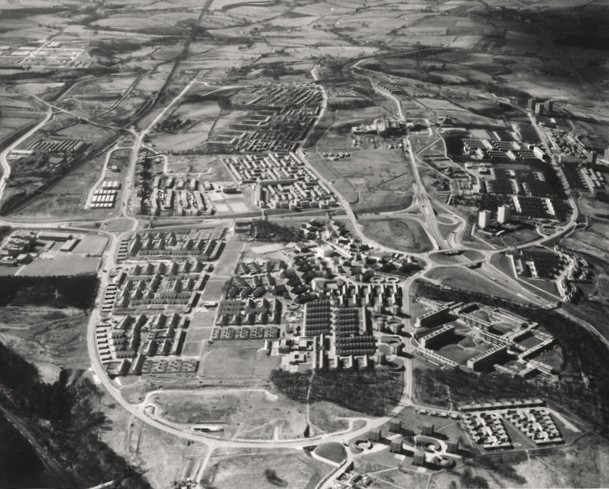
Cumbernauld - opened in 1955
During the 1950s the DHS also conceded to Glasgow a number of building sites in the Green Belt, with the City developing each of these sites at as high a density as possible, with modern style tenements rather than cottages. In this way, over 9,000 dwellings in large schemes (‘Peripheral Areas’) were built at Pollok/Priesthill, over 8,500 at Castlemilk, 7,500 at Garscadden (Drumchapel), and over 10,000 in the Eastern Areas (i.e. Barlanark/ Garthamlock/Easterhouse). Smaller green belt developments included, for example, Arden, Cranhill, South Nitshill and Milton.
By 1954, the Corporation's output had risen to above 6,000 annual completions, far higher than those of other British provincial cities, and diametrically opposed in architectural form to their cottage-building programmes.
Thousands of flats, in uniform four storeyed tenement blocks, were now multiplying all around the edges of the city. This was almost a mirror image of the late 19th century building boom, except that the new tenements contained three and four apartment flats built in roughcast or terrazzo faced brick or block work, rather than single-ends and two apartments in masonry. Also, their construction was carried through not by the market driven initiatives of numerous small builders, but by large, negotiated contracts with a consortium of large local firms and the Corporation’s own building department, the Direct Labour Organisation (DLO).
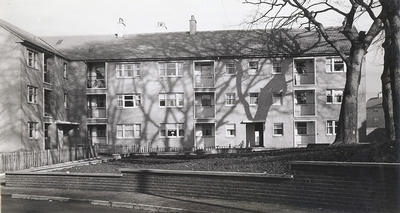
Duntavie Quadrant, Easterhouse
It is generally accepted that this new housing significantly improved living conditions by providing indoor amenities like toilets, running hot and cold water, separate bedrooms and bathrooms, gas cookers etc., and offering better overall living space compared to the often overcrowded and insanitary pre-war tenements. Modern amenities in modern style houses were the future for working class people in Glasgow. Nevertheless, issues remained with respect to the lack of amenities within the schemes themselves, lack of community cohesion and isolation issues given they were built on the outskirts of the city.
Inner City Development
During the 1950s a detailed plan for Comprehensive Development Areas (CDA’s) also came to the fore which aimed to demolish inner city slums and replace them with new modern housing schemes.
The first area to be redeveloped, Hutchesontown-Gorbals used a formula evolved from the mixed development projects of the London County Council, where four storeyed flats and maisonettes were mingled with a limited number of multi-storey point blocks and slab blocks up to 16 storeys in height. The first schemes for Hutchesontown were commissioned from architects Robert Matthew and Basil Spence, both proponents of modernism in housing. Considered the centrepiece of this development, Spence’s tower blocks (Hutchesontown C) were inspired partly by Le Courboisier’s giant maisonette blocks in Marseille and consisted of two brutalist 20-storey slab blocks with quirky design features such as insert communal balconies.
Following on the heels of the Hutchesontown/Gorbals initiative, The 1957 Report on the Clearance of Slum Houses, Redevelopment and Overspill advocated the ending of new house building in the city except for 29 slum redevelopments.
These projects involved the clearance of 29 areas and aimed to relocate a significant portion of the affected population. The primary goal was to replace existing, often dilapidated, housing with modern structures and infrastructure. Another major component of the CDA program was the relocation of residents, with a target of relocating 60% of the affected population.
The 29 CDA’s proposed were Hutchesontown, Pollokshaws, Maryhill, North Kelvinside, Hamilton Hill, Possil Park, Springburn, Sighthill, Garnethill, Cowcaddens, Townhead, Robroystonhill, Wellpark, Whiteinch, Partick, Anderson Cross, Glasgow Cross, Gallowgate, Elder Park, Govan, Kinning Park, Govan, Shields Road, Laurieston, Bridgeton, Govanhill, Polmadie, Parkhead, Shettleston, Tollcross.
As anticipated by the 1957 Report, large areas of the slum belt were demolished in districts such as Pollokshaws, Springburn, Govan and the Gorbals, and mixed housing developments of high and low blocks were in course of erection in their place. Similarly, areas such as Kinning Park, Anderston, Cowcaddens, and Townhead were demolished to make way for the M8 motorway. Not all the CDA’s were followed through and plans for redeveloping Glasgow Cross, Gallowgate and Bridgeton for example were abandoned.
The 1957 Report predicted the building of 40,000 houses in Glasgow and 60,000 overspill houses by 1980. In fact, by 1972 a mere 25,000 planned overspill dwellings had been provided, and 48,000 houses had been built within the city boundaries.
Nevertheless, the CDA program significantly changed the urban fabric of Glasgow's inner city. It led to the creation of new housing and infrastructure, but also resulted in the loss of historic neighbourhoods and displacement of residents.
Tower Blocks
One major opponent of the 1957 plan was David Gibson, the Housing Committee’s convener from 1961 to 1964 who took the view that the imperative was to build as many new dwellings as quickly as possible. He believed the 1957 report would fail to rehouse slum-dwellers directly into new houses at least until the mid-1960s and that 'there is enough land in Glasgow to build all the houses we need if only we can find.'
In 1958, Gibson took the initiative, arguing that if the high blocks proposed for limited use in the CDAs could be employed outside these areas on gap sites at much higher density they would bridge the critical five-to-ten-year gap before the first big slum-cleared sites became free for development. This would be achieved by accommodating those displaced by slum-clearance and minimising the need for overspill.
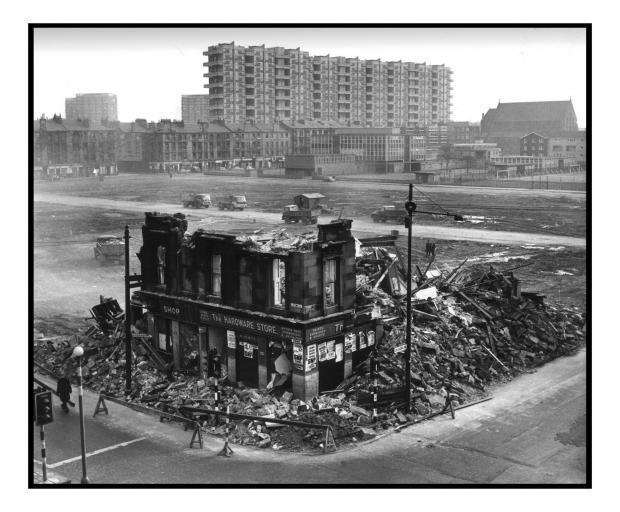
In 1960, Wimpey demonstrated the potential of tower blocks in gap sites by erecting the structure of three 20 storey blocks at Royston in eight months. Impressed by Wimpey’s ability to house a sizeable population on a relatively small area of land within a short period, the Corporation took the bull by the horns and followed suit, unleashing the most concentrated multi-storey building drive experienced by any British city.
High flats accounted for nearly three-quarters of all completions in 1961-8, compared with less than 10% for all other years between 1945 and 1974. This increased the level of output as a whole, from 1,902 completions in 1962 to 4,318 in 1964. Notable examples include the group of ten Crudens slab blocks of twenty storeys dotted across a vast reclaimed chemical wasteground at Sighthill, and the eight multi-storey steel framed Red Road flats at Balornock designed by City architect Sam Bunton showcasing a hard-edge brutalist style.
Building New Slums
By the end of the 1960s the character of schemes such as Sighthill or Red Road were called into question.
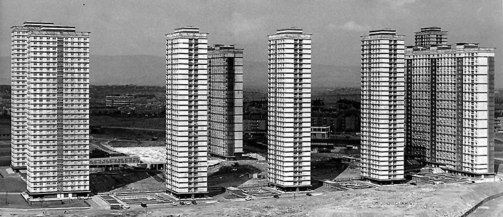
Red Road tower blocks in 1967
Red Road became a particular focus of controversy. The first two tower blocks completed, in 1966 (Blocks 1 and 2), contained only four and five room houses, and the high proportion of children, combined with inadequate lift provision, created a reputation for juvenile delinquency which blighted the entire scheme. Block 2 (33 Petershill Drive) was considered the 'worst' on the scheme; for example, a tenant complained to the Corporation in September 1970 that an old lady’s hat had been 'pulled from her head because she had the temerity to check boys who were stoning the watchman’.
Similarly, the 1971 report ‘Homes in High Flats’ by eminent social researcher Pearl Jephcott investigated the experiences of residents in Glasgow's high-rise social housing in the late 1960s. The report highlights both the positive and negative experiences of residents, revealing that while some appreciated the modern amenities and views, others faced social isolation, particularly women and children, due to the design and lack of community spaces. The study also touched upon the impact of high-rise living on children, finding that it could exacerbate issues like hyperactivity and delinquency.
The report addressed practical concerns such as the lack of accessible and safe play areas for children, the difficulties of summoning help from the elderly and infirm, and the challenges of maintaining social connection. While initially seen as a solution to the housing shortage, the study contributed to the growing question of the suitability of high rise living for families and the need for more community focused housing designs.
The 1970s also saw tenant campaigns come to the fore which highlighted major issues with the conditions of some of the new housing, particularly dampness. For example, the Gorbal’s 'Anti-Dampness Campaign’ was formed in 1975 to lobby the Council to take action in improving homes and/or relocating residents to suitable homes. The focus was on Hutchesontown or ‘Hutchie’ E where the flats constructed were known as ‘the dampies’. The Campaign included a rent strike in 1976 and received support from tenants as far afield as Wester Hails in Edinburgh. By 1977 the Council accepted that significant work was required to make the flats habitable. Some councillors even suggested that the flats should be demolished, a sentiment shared by the leaders of the Campaign. Hutchesontown E was eventually bulldozed in 1987 prefiguring a slew of tower block demolitions (including the Red Road flats in 2015) whereby of the 230 blocks initially built only 67 remain as of today.
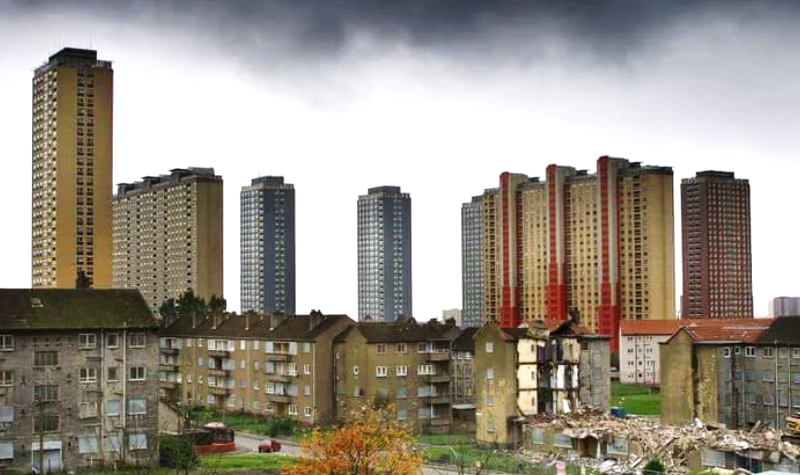
Red Road tower blocks – demolition started in 2012
A Change of Focus
By the late 1960s and early 1970s the Planning Department began to exclude multi-storey blocks from new developments, both within the CDAs and in outer-suburban locations such as Summerston, and to impose a maximum blanket density of 110 persons per acre (p.p.a.). As demolition of the older tenements continued, dense courtyard groups of low, brick-built terraces began to spring up in areas such as Partick and Maryhill.
The breathing space created by the high flat boom nevertheless led to the Corporation accelerating CDA clearances to a colossal scale. During the first half of the 1960s, clearances had proceeded on a small-scale basis of about 2,000 dwellings a year, concentrated on the worst pockets of mid-19th-century slums. By the end of the 1960s these had increased to about 6,000, a year with entire areas built during the 1870s and 1890s, such as Springburn or Govan, being razed. The peak of activity was in 1970-2, when 19,000 dwellings were demolished or closed.
The pace of demolitions was such that the worst slums were largely eradicated by the early 1970s. The Corporation’s focus henceforth changed towards visual repair and social-economic regeneration. This included the patching up of CDA gaps or dilapidated council estates, and the encouragement of new industry and employment in depressed areas. For example, a range of regeneration initiatives were devised within the framework of Strathclyde Regional Council's Areas for Priority Treatment programme. For example :
- In the outer suburbs there were projects such as the Priesthill-Nitshill Initiative (from 1978), an attempt to remedy social deprivation and physical destruction in a 1940s scheme.
- Within the CDA zone, there was the Maryhill Corridor Project (from 1977), where the entire length of Marshall Road and adjoining streets were either rehabilitated or redeveloped with bright red-brick terraces.
- The Glasgow Eastern Area Renewal (GEAR) project was another major urban regeneration initiative in the East End of Glasgow from 1976 to 1987. It focused on revitalising the area by refurbishing and modernising existing housing stock rather than simply demolishing and rebuilding, aiming to avoid the mistakes of previous developments. GEAR also aimed to improve the overall community by addressing issues like public transport, shopping facilities, and community spirit.
By 1979, sixty years of building since the Addison Act had expanded the share of public housing-council from 1% to 64%, compared with a Scottish average of 54% and a UK average of 32%. Also, further to the pursuit of overspill, the years 1971-81 saw a 15% fall in the city's population.
1980s Downturn
The 1980s saw Glasgow experience a significant downturn in council house building, caused by a number of factors.
The “Right to Buy” scheme was introduced by the UK Government in 1980 which allowed council tenants to purchase their homes at discounted prices. This policy significantly reduced the number of council houses available, particularly in more desirable areas.
The 1970s and 1980s also saw a general decline in heavy industries like shipbuilding and coal mining in Glasgow, leading to widespread unemployment and urban decay. This economic hardship made it challenging for the council to maintain and invest in its housing stock. Areas with high concentrations of council housing, like the Red Road flats, faced a decline due to poor management, high unemployment, and social issues. This led to a perception of these areas as undesirable, further impacting on the council's ability to maintain and develop them.
While council building slowed, there was a growing focus on regenerating existing housing stock, particularly tenements in inner-city areas. This involved initiatives like Comprehensive Tenement Improvement (CTI), which provided grants for upgrading older properties, and the rise of Community Based Housing Associations (CCHAs).
Moreover, probably the one most significant infraction into council house ownership occurred in 2003 when Glasgow City Council transferred its entire housing stock of 81,000 homes to the newly formed Glasgow Housing Association (GHA). This transfer, following a tenant ballot where 58% voted in favour, aimed to modernise the housing stock and address the city's housing debt.
The combined effect of these factors was a reduction in council housing and a shift towards a more mixed housing market, including increased private ownership and the rise of housing associations which remain to this day.
Recap
The public housing boom in Glasgow had its origins in the collapse of the private housing market at the beginning of the 20th century, and the pressing need to remove a growing population from slum conditions.
By the 1960s, Glasgow house building had reached its furthest point of departure from the small-scale Victorian operations of firms, with the Corporation allocating schemes of several thousand dwellings at a time and eventually becoming the largest public sector landlord in Europe.
Although the Corporation’s lofty ambitions to create better housing conditions for the city’s burgeoning working population were largely met, issues such as the isolation of communities, lack of amenities and construction flaws (e.g. dampness) have tainted this legacy somewhat.
Today Glasgow’s landscape of towers blocks and peripheral estates remain, unequivocally serving as a reminder of what was achieved by this grand, civic but flawed public housing development experiment.
Bibliography
Abercrombie, Sir P. and Matthew, R. H., The Clyde Regional Valley Plan, 1946: A Report. Clyde Valley Regional Planning Advisory Committee Report to the Constituent Local Authorities,1947 (Edinburgh Stationery Office, 1949).
Abrams, L. et al, ‘Isolated and dependent: women and children in high-rise social housing in post-war Glasgow’. Article published by Taylor & Francis Group in Women's History Review on 20 May 2018. Available online: http://www.tandfonline.com/10.1080/09612025.2018.1472897].
Abrams, L. et al, Glasgow: High-Rise Homes, Estates and Communities in the Post War Period (Routledge, 2020).
Bruce, R., First Planning report to the Highways and Planning Committee of the Corporation of the City of Glasgow (Corporation of the City of Glasgow, 1945).
Bruce Report Wikipedia. Available at https://en.wikipedia.org/wiki/Bruce_Report (Accessed 12 July 2025).
Damer, S., Scheming: A Social History of Glasgow Council Housing, 1919-1951 (Edinburgh University Press, 2020).
Glasgow, UK Housing Wiki Fandom. Available at: https://ukhousing.fandom.com/wiki/Glasgow (Accessed 20 July 2025).
Glasgow’s Local Housing Strategy 2017-2022, Housing Change Timeline (Glasgow City Council, 2022). Available at: https://www.glasgow.gov.uk/media/8918/Glasgow-s-Housing-Timeline/pdf/GlasgowsHousingTimelineFinal_002.pdf?m=1702043046483 (Accessed 30 June 2025).
Glendinning, M. & Muthesius, S., Tower Block: Modern Public Housing in England, Scotland, Wales and Northern Ireland (Yale University Press, 1994). Available at: https://towerblock.org/TowerBlock.pdf.
History of Glasgow, Wikipedia. Available at: https://en.wikipedia.org/wiki/History_of_Glasgow (Accessed 25 May 2025).
Housing in Glasgow, Wikipedia. Available at: https://en.wikipedia.org/wiki/Housing_in_Glasgow (Accessed 15 May 2025).
Horsey, M., Tenements and Towers: Glasgow Working-Class Housing, 1890-1990 (Edinburgh, 1990). Available at: https://i.rcahms.gov.uk/canmore-pdf/WP00003948.pdf.
Jephcott, P., ‘Homes in High Flats: Some of the Human Problems Involved in Multi-Storey Housing’ (Routledge, 1971)
O’Brien, I., (2022) ‘Peripheral Estates - Times Past’, Glasgow Life blog, 28 September. Available at: https://www.glasgowlife.org.uk/libraries/family-history/stories-and-blogs-from-the-mitchell/times-past-blogs/peripheral-estates-times-past (Accessed 9 June 2025).
O’Brien, I., (2022) Comprehensive Development Areas - Times Past’, Glasgow Life blog, 16 November. Available at: https://www.glasgowlife.org.uk/libraries/family-history/stories-and-blogs-from-the-mitchell/times-past-blogs/comprehensive-development-areas-times-past (Accessed 17 June 2025).
O’Brien, I. (2024) Multi-Storey Flats - Times Past’ Glasgow Life blog, 10 January. Available at: https://www.glasgowlife.org.uk/libraries/family-history/stories-and-blogs-from-the-mitchell/times-past-blogs/multi-storey-flats-times-past (Accessed 25 June 2025).
Paice, L., Overspill Policy and the Glasgow Slum Clearance Project in the Twentieth Century: From One Nightmare to Another? Article in ‘Reinvention: A Journal of Undergraduate Research, Volume 1, Issue 1’ (University of Warwick, 2008). Available at:
https://warwick.ac.uk/fac/cross_fac/iatl/research/reinvention/archive/volume1issue1/paice/ .
Scottish Roads Archive (2023), ‘Comprehensive Development Areas: An Overview’, January. Available at: https://www.scottishroadsarchive.org/cdas.
Wright V, ‘Housing Problems are Political Dynamite’: Housing Disputes in Glasgow c. 1971 to the Present Day. (Sociological Research Online, 26 (4), pp. 976-988, University of Edinburgh 2018). Available at: https://doi.org/10.1177/1360780418780038.