Pre-industrial Glasgow and the early days of the Industrial Revolution in Glasgow
By Rachel Kelly
The Burgh of Glasgow celebrated its 850-year anniversary in 2025. Glasgow as the settlement that it is today, includes many outlying villages that were annexed to the Burgh of Glasgow in the later 19th Century, and occasionally before. The Ice Age of 10,000 years ago formed drumlins that make up the many hills such as Govanhill and Partickhill, to name only a couple, which form the Glasgow of today. Prior to this, tropical forests rotted down to form the coal that would partly power the start of the industrial age and beyond, and the sandstone which would be used to build many of the city’s buildings during the 18th and 19th centuries.
Evidence of pre-historic settlement in the area surrounding Glasgow was found as early as 1885, when the Concho Stone was found North of Duntocher. Pre-historic log boats have also been discovered in the Clyde. Most recently, in a community archaeological dig in August 2025, what is thought to be at least five round houses, typical of the Bronze and Iron Ages, and thought to be at least 2000 to 3000 years old, were found near the medieval Crookston Castle in Southwest Glasgow. It is hoped that further digs will provide evidence of how people were living in the area then.
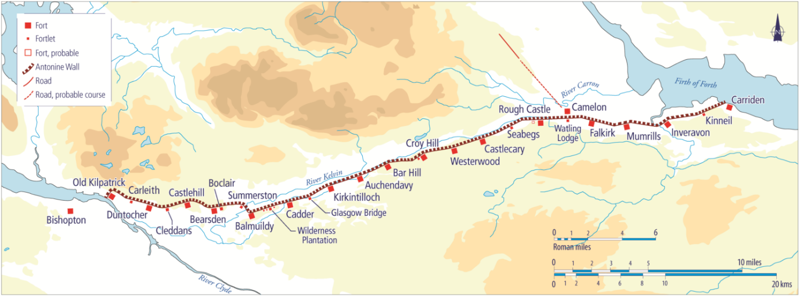
Map of all forts and fortlets along the Antonine Wall © David Breeze, courtesy of HES
Sections of the Roman Army were in forts in the Glasgow area for around 20 years from AD 142 after they pushed north, having earlier left Scotland after the battle of Mons Graupius in AD 83 or AD 84. They returned under the orders of Emperor Antonius Pius, Emperor Hadrian’s successor, who commanded the building of The Antonine Wall. This was built as the northern most frontier of the Roman Empire, which stretched from the Firth of Clyde to the Firth of Forth, over 39 miles. The Romans never at any stage-built villas or civilian towns in Scotland, but they did build 16 forts in total on the wall, with fortlets in between, including at Bearsden where a Roman bathhouse can be seen. It is also thought that they might have had a fort near the Clyde in present day Yorkhill, in the west of the city. Although these were army forts, archaeological evidence shows that there were women and children living there, as well as slaves for more important people. Within the forts, there were bath houses where the soldiers would have spent leisure time bathing and gambling. Adjoining Roman settlements would have had pubs and shops. Indigenous tribes living locally would probably have interacted with the Roman camps. By AD 383, the Romans had left the North of Britain and left Britain entirely by AD 410.
The Kingdom of the Britons, the name of an ancient Welsh speaking people who settled along the River Clyde, ruled for much of the first millennium. It was they who founded the city of Glasgow. Their original base at Dumbarton Rock suffered a Viking raid in 870AD and it is thought that it was moved to what is now Govan (evidence of Christian burials there date back to the 5th century). There they formed the Kingdom of Strathclyde, of which information is scant. Finds at Govan Old Church give some clues, including Hogback Stones dating from the 9th to the 11th century, which point towards strong links between this Kingdom and the Scandinavian world. Other carved stones found of the period in Scotland, have depicted Viking Longhouses. In the middle-ages, the Kingdom of Alba took over the Kingdom of Strathclyde.
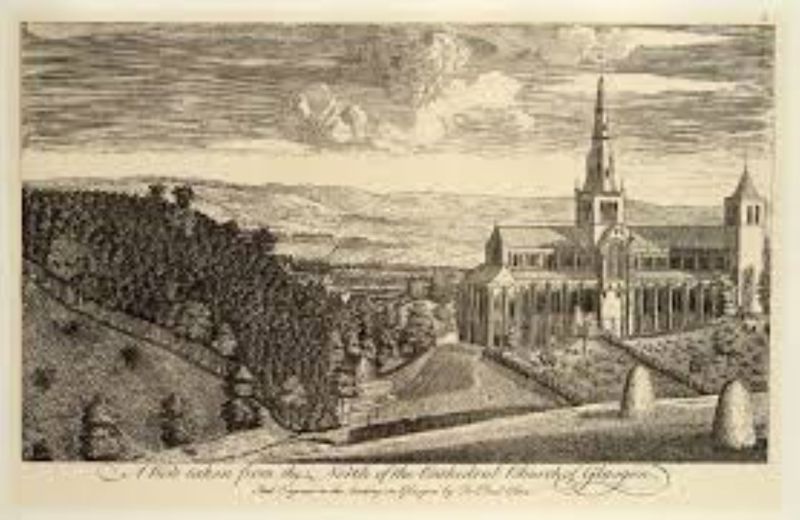
Glasgow Cathedral
Glasgow Cathedral was founded in 1136. It is the oldest building still standing in Glasgow. It was originally surrounded by farmlands and cottages (thought to be wattle and daub). It was built in the area said to have been founded by St Mungo in the late 6th century, and became the major ecclesiastical centre for the West of Scotland. In 1190, the first Glasgow Fair too place and a market was set up. The High Street was developing in the early 13th century and by 1285 it was well established. The Trongate and Gallowgate were there, and Glasgow Cross was where most market stalls would have been.
Glasgow University was founded in 1451 by a papal bull for Pope Nicholas V. It was initially a part of Glasgow Cathedral; it was then situated on Glasgow’s High Street until 1870, when it moved to the West End. The university’s students would have been part of the Burgh’s population and contributed to its intellectual life; participants came from all social classes during that early period.
In the 16th century Glasgow had a university, a cathedral, and was a market town, carrying out trade locally and occasionally further afield; it had a population of around 4,500 people. Other market towns in Scotland at the time were bigger.
Aileen Smart, in her book, ‘Villages of Glasgow, Volume 1’, wrote: ‘It has often been said that the history of Glasgow is the history of its villages.’ Most of these, roughly 19 villages, were outside the boundaries of the Burgh of Glasgow until later; nevertheless, some of them had been important in the overland trade in linen and linen yarn opened up after the Union of the Crowns in 1603. They also contained the seeds of much of the industry that was to be important in forming the beginnings of the city’s industrial revolution. To give areas of what is now the East End of Glasgow as an example, pre-18th century Camlachie was a small village where weavers would have worked from home; and Westmuir had a colliery that formed part of West Central Scotland’s rich seams of mineral resources, which were some of the best in the country.
Throughout the 17th century the merchants of Glasgow practised illegal trading with the colonies, prior to the Union of Scotland and England in 1707. Markets closer to home included the Highlands and Ireland, which used, amongst other things, linen from Glasgow’s outlying villages. They did not have the advantages of being on the East Coast for Baltic and European trade, however. The burgh of Glasgow remained much the same in terms of its area coverage as during medieval times.
Following the Treaty of Union in 1707, Glasgow’s merchants were fully able to take advantage of colonial trade, which involved the exploitation of people brought to the colonies by the brutal Atlantic Slave Trade. They also traded in tobacco, cotton, and sugar, with the huge British Empire. The most notable merchants included Glassford, Ingram, Gordon, and Buchanan, who still have Glasgow streets named after them; they each made vast amounts of money and could be seen around Glasgow flaunting their wealth by wearing the best silks and carrying gold topped canes. They also built what is now known as the Merchant City, and large mansions such as the building that now contains the Gallery of Modern Art, and expanded the Burgh of Glasgow with buildings further to the west and into the Gorbals; by the early 19th century, one street of fine houses stood at Carlton Place, in stark contrast to nearby utilitarian two storey buildings. Shops sprung up to sell fancy goods to furnish these grand homes and meet the expensive tastes of their residents. Fires in 1652 and 1677 resulted in a decree that all future building should be of stone, and the new stone buildings, which were centred around the Trongate and the Saltmarket as far as the Clyde, were built alongside the older town with the Cathedral and the upper part of the High Street.
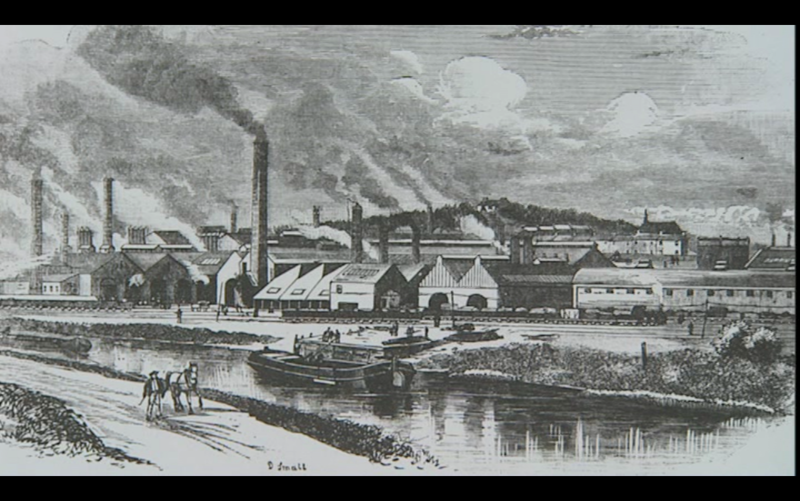
Forth and Clyde Canal
Although the tobacco trade tailed off slightly during and after the American Wars of Independence (1775-1783), some of the merchants were shrewd enough to diversify into other industry and exports. Using money made from the tobacco trade, which included the enslavement of people, the merchants were able to finance further trades and the development of new industry; transport efficiencies were made when they partially bankrolled the Monkland Canal and the Forth and Clyde Canal, which were completed in 1795 and 1790, respectively. The Forth and Clyde Canal enabled goods to be moved in a way that was not possible in the past due to goods having to travel round the treacherous Pentland Firth. Ships coming from the West had to dock at Port Glasgow as the Clyde was not dredged deep enough to take cargo ships until 1812. The Forth and Clyde Canal also enabled products such as pig iron to be brought into Glasgow to create further industry from 1770 to 1830, as in the creation of early iron foundries, such as the one opened at Camlachie in 1814. The Monkland Canal brought in coal from Lanarkshire to fuel this and other industries.
This increasing trade in the 18th century meant that small villages like Anderston, which lay to the west of the burgh of Glasgow, gradually grew in size to join existing neighbouring weaving villages, thereby contributing to the wider city’s international trade, not only in linen and then cotton cloth (from the 1760s), but also in other goods, such as leather, chemicals, turkey red dye, breweries, and more. Anderston had become a weaving village in the 1720s. The weavers there and in other villages worked from home until the coming of the factories in the late 18th and early 19th century. The homes that they were given were comfortable despite the damp conditions that were necessary for home weaving, and had areas outside for growing vegetables, which would have helped them to be self-sufficient. The majority of ground floor properties in Bridgeton had a handloom during this period. Glasgow was Britain’s leading linen town by 1770, with a reputation for a good product, and after the decline of the tobacco trade, weaving was Glasgow’s biggest employer by 1787, with 60,000 people employed.
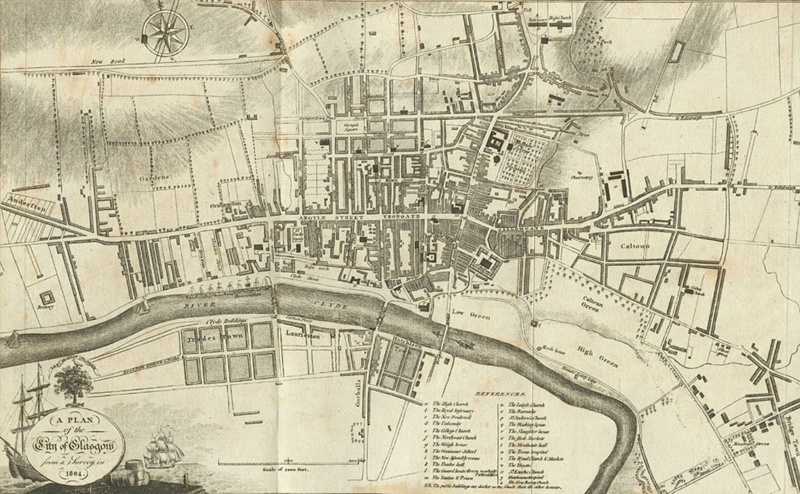
Map of Glasgow engraved by Robert Scott, 1804. Source: Mitchell Library, GC 941.435 DEN
The population of Glasgow increased to around 200,000 people by 1830. People came to Glasgow from across Scotland and Ireland. Highlanders had been moving to the Lowlands of Scotland since the 17th century, but this increased during the 18th and early 19th century due to the Jacobite rebellions and the Highland Clearances. Lowlanders, some of whom were skilled in weaving, came to Glasgow in large numbers during the Lowland Clearance that was caused by increased mechanisation in farming during the early 19th century. Both Protestant and Catholic Irish people came to Glasgow in this period. The Protestant Irish were often skilled in weaving. The Catholic Irish had been coming throughout the 18th and early 19th century to do seasonal farm work. The arrival of steamboats on the Clyde from Ayrshire and Greenock, and which eventually went to Liverpool and Belfast, would have facilitated their movement to work on the canals and in the growing number of factories in Glasgow. These factories came about as a result of improvements in technology in the late 18th and early 19th century, including the power loom, which was patented in 1785.
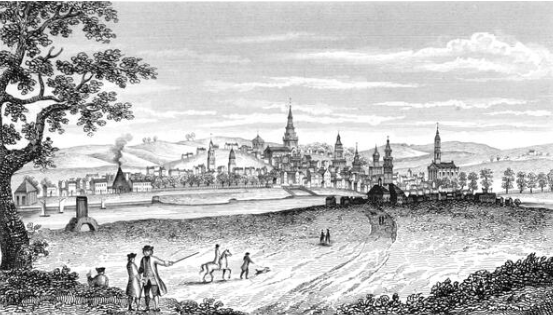
A View of Glasgow from South of the River Clyde, 1788
The increasing numbers of people and factories brought about a number of issues for Glasgow and its surrounding villages. The water supply to Glasgow and surroundings remained medieval until 1840, despite efforts to change this. Its sources were local springs and the River Clyde, which became increasingly polluted due to industrial effluent being released and the sewage from an increasing population. This brought cholera in its wake. Overcrowding brought the spread of other diseases, such as typhus and smallpox. Smallpox caused 19 percent of deaths by the end of the 18th century. These developments, along with increasing industrial fumes around the River Clyde, pushed the wealthier people to move out to the suburbs of the West End. Building of accommodation for the increasing population took off in the burgh of Glasgow in the early 19th century. Although built of stone rather than wood, wattle and daub, these homes were not of a good standard.
Unskilled workers entering the workforce and undercutting the wages of the formerly artisan weavers was partly the cause, along with a deterioration in pay and conditions as factories came in. Scotland’s first industrial action was carried out by weavers from the Calton, in 1787, and resulted in three deaths. There were riots in 1778, against giving poor relief to Irish Catholics. Both Protestant and Catholic Irish people were subject to the anger of locals for political and economic reasons. The recession at the end of the Napoleonic wars (1803–1815) also brought about competition for work. Post-Waterloo, as in other parts of the country, there was agitation for change in Glasgow. This came to a head with the Radical War of 1820, during which 40,000 people met on Glasgow Green to protest against the corn-laws and to ask for increased political franchise. The latter was brought about in 1832 with the Reform Act. There were also a number of other riots in Glasgow between 1770 and 1830, including food riots, brought about by food shortages caused by the increased population.
Cholera in slums dwellings, 1800s
Some improvements were made to the Burgh of Glasgow during the early 19th century. Glasgow’s Police Board brought in street cleansing, refuse collection, and a fire service. Gas street lighting was introduced in 1818. Glasgow Green was developed as an area for recreation. Improvements were made to food supply and markets. After 1830 a new era of further industrialisation, new housing, and the expansion of its boundaries dawned for Glasgow, accompanied by the coming of the railways and the eventual deepening of the River Clyde, which further improved transport links to wider trade markets.
Bibliography
Donald Erskine, Glasgow’s History Rewritten by 3000-year-old Prehistoric Discovery, 14th of April 2026, The Herald
John R Hume, Industrial Revolution: 1770s to 1830, Industry and Technology, Iron and Steel, The Glasgow Story .com, Accessed April 2026
Camlachie Foundry, Graces’s Guide to British Industrial History, gracesguide.co.uk, Accessed April 2026
Amy Irvine, the University of Glasgow, historyhit.com, Accessed April 2026
Michael Meighan, Glasgow A History, 2013, Amberley Publishing
Alistair Moffat, Glasgow: A New History, 2025, Birlinn Limited, Edinburgh
Aileen Smart, Villages of Glasgow Volume 1, 1997, John Donald Publishers Ltd, Edinburgh
Aileen Smart, Villages of Glasgow Volume 2, 1998, John Donald Publishers Ltd, Edinburgh
Irene Maver, Industrial Revolution: 1770s to 1830s, Culture and Leisure, Migrants, Theglasgowstory.com, Accessed April 2026
A Brief History of Romans in Scotland, nms.ac.uk, Accessed April 2026
The News Room, When Prehistoric People Lived around Glasgow, 13th of June 2018, The Scotsman
Michael Moss, Industrial Revolution 1770s to 1830s, Theglasgowstory.com, Accessed April 2026
Thegovanstones.org.uk, Accessed April 2026