WWI and the 1915 Glasgow Rent Strikes
By Roisin Stewart
Between 1914 and 1918, half of Scotland’s male population aged between 18 and 45 years had joined up to go to the front to fight1, but this did very little to ease Glasgow’s overcrowding problem. Indeed, with Glasgow being a munitions hub for both steelworks and shipbuilding, tens of thousands of new workers entered the city during the first year of the war alone2, driving up the demand with no increase in supply.
6 https://www.iwm.org.uk/collections/item/object/28448
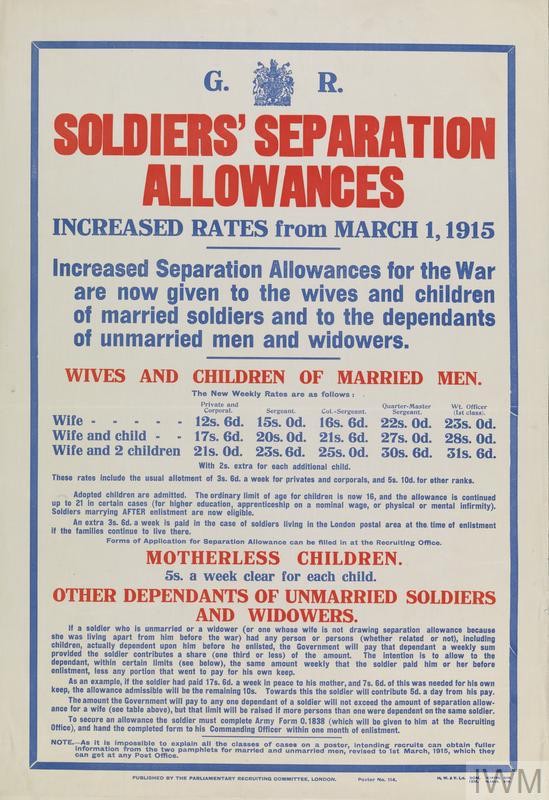
As Glasgow had not yet invested in municipal housing, this generally left tenants at the mercy of private landlords. (Affordable housing had been campaigned for, most famously perhaps by John Wheatley, who proposed the Glasgow’s Tramway Department’s profits be used to build affordable housing. His 1913 publication ‘Eight Pound Cottages for Glasgow Citizens’ set out his proposals but was unsuccessful at the time - though its existence documents that Glasgow City Council, then called the Corporation, were aware of the housing issue3.) Chair of the Landlords’ Association, Mr. Speirs, advised his members in January 1915 that, “This is a time for raising rents and us members not to miss this opportunity,”4 which saw Glasgow landlords increase rents by 25% in February of that year.5 The stark reality was - people could not afford it. Women whose breadwinning husbands were at war were reliant on the government’s Soldier’s Separation Allowances.
But these had been calculated on prewar wages - as had the pay rates of the men who had stayed to continue working in reserved occupations. Prewar wages could not accommodate a 25% increase in rent. Evictions increased - in 1913, 484 people were evicted, in 1914 this increased to 738, but in the first three months of 1915 alone, 6441 people were evicted from their homes.7 Outrage soared and led to one of the most famous social resistance movements in housing history - the 1915 Rent Strikes.
9 Poster: https://www.bbc.co.uk/bitesize/guides/ztx66sg/revision/4
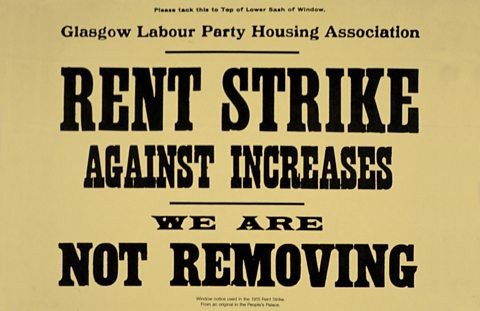
The Glasgow Women’s Housing Association, with Mary Barbour, who would go on to be an elected councillor, at the helm8, mobilised - meetings to discuss how to resist the rent rises were held all over Glasgow and from April of 1915, people refused to pay the increased rent. They would pay only the prewar rent amount, pushing them into arrears - which would lead to threat of evictions. But, quite simply, they had decided they wouldn’t be evicted. Residents put signs up in their windows stating, ‘We are not removing.’
The working class were living still in the old Glasgow’s tenements at this time, and the physical make up worked in the women's favour. Information could be spread quickly across backcourts. To allow people to get on with their days, one woman would be posted as lookout. When the factor was spotted on his way to act upon a served eviction notice, word would spread, bells and football rattles would be sounded to get attention, and people would descend on the address threatened. A tenement’s entryway is easily blocked by a mass of people.
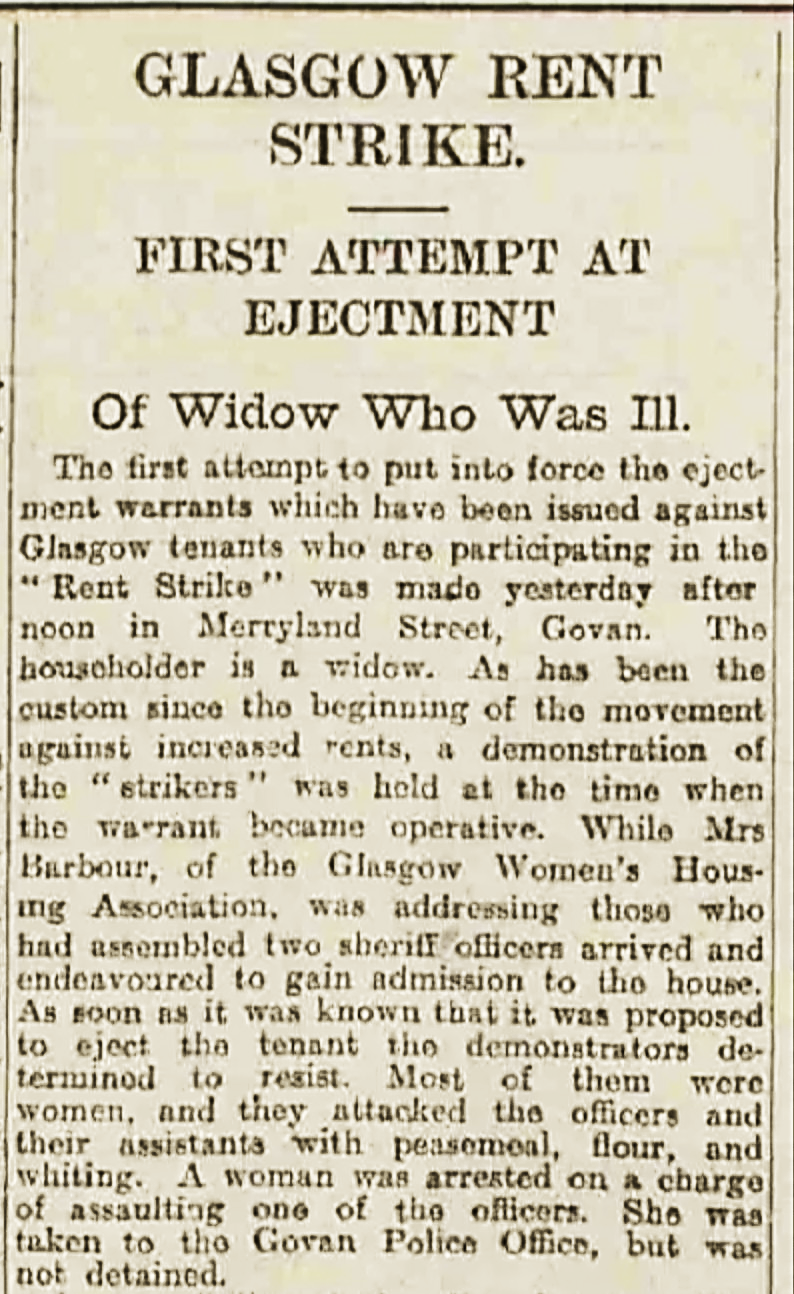
In addition to blocking entry, the assembled women would attack with whatever they had available. As the lyrics to Alistair Hulett’s song, ‘Mrs Barbour’s Army’, go, ‘We’ll run oot an’ chase the factor a’ the way tae kingdom come, When the poor wee soul cam roon’, he was battered black and blue, By a regiment in pinnies that knew just what tae do.’11 The first attempt to evict a rent striker was reported widely upon across various newspapers, and the reports say that the two sheriff officers involved were attacked with peasemeal, flour and whiting.12
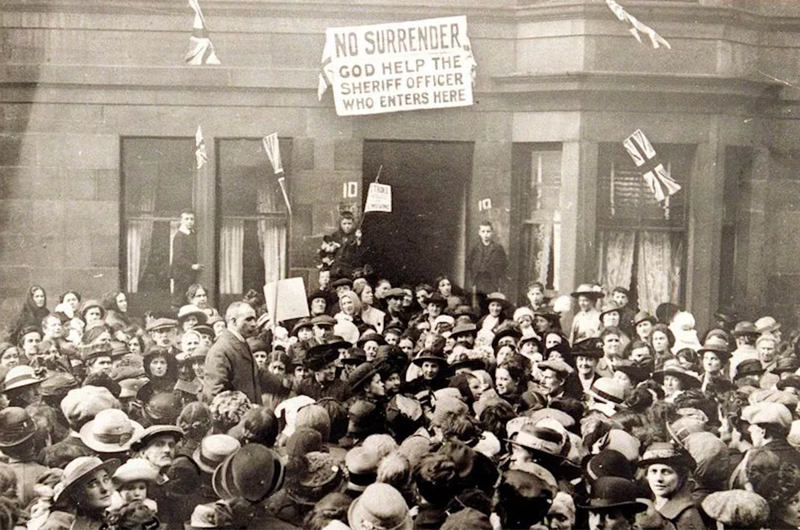
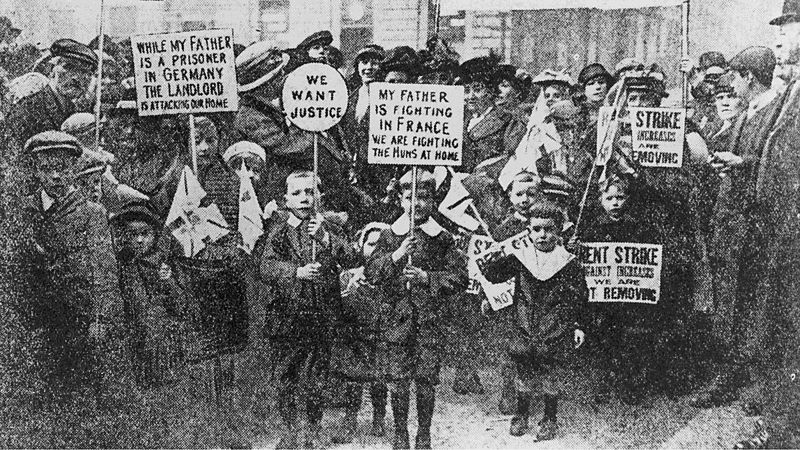
As well as resistance in the face of evictions, the rent strikers held demonstrations.
14https://www.bbc.co.uk/sounds/play/p01sgk4m
13https://govanshiddenhistories.wordpress.com/2016/05/15/remembering-the-rent-strikes-guest-post/
It is important to consider this action very much in the context of having The Great War as its backdrop - we can see clearly in the photograph above that two signs make reference to the war, drawing parallels between the attack of war, which absent fathers are fighting in, and the attack of the landlords on the homefront.
The rent strikes of Glasgow inspired similar movements elsewhere - within Scotland Dundee, Aberdeen, Kirkcaldy and Leith all saw action15 and further south there were rent strikes in Northampton, Birmingham, areas of London and in Birkenhead.16 This political language was replicated, with a Birkenhead placard declaring “Father is fighting in Flanders, we are fighting the landlords here.”17 With the government feeling that keeping morale high amongst the population was in the interests of the war effort, the language used demanded attention.
In October 1915 Alfred Yeo, the Liberal MP at the time for Tower Hamlets Poplar, addressed the house with the following:
I warn the landlords in this House that their action in raising rents at a time when this country is engaged in a life and death struggle, when the noblest and best of her sons are giving their life's blood to defend hearth and home from German horrors, to defend their wives and children, and also the wives and children of the landlords, is wrong. Many of the landlords, in order to show their appreciation of the excellent work that the soldiers are doing in the trenches, have sent notices saying, in effect, "We are proud of you. You are fighting to keep us from the German invasion. To show our appreciation of what you are doing at the front, we have decided in your absence to raise your rent 1s. a week, or to turn your dependents into the street." I suggest to- night to the Government that not only should a strong word come from the Front Bench, but that a small measure should be brought in to make it less possible during the War that our gallant men and their wives and children should be worried and harassed by the landlord at this stage whilst the men are away from home. I also want to warn the House and the landlords that, in my opinion, this kind of thing is going to sow industrial discontent and unrest. It will not end whilst the War is on. I do not desire to defend those tenants who do not want to pay the rent for the houses in which they live. I am not here to champion their cause. But I am here to say that it is unpatriotic for the landlord to increase the rent of houses…
George Barnes, MP for Glasgow Blackfriars and Hutchesontown, subsequently pointed out in this session that he raised concerns in February 1915 over the comments made by Mr Spiers regarding increasing rents:-
I called the attention of the Prime Minister to a declaration made by the president of an association—I think it is called the Householders' Association of Glasgow, or something of that sort—which had been made on 14th January. The declaration was to the effect that now was the time to raise rents, since people were getting accustomed to the rise in prices. I called the attention of the Prime Minister to the statement, and he did not agree with me as to the full significance of it, but he said that if it were borne out by events, or if I could bring forward any concrete illustration, showing that that policy was to be given effect to, then the matter would have the serious consideration of the Government. In consequence of that statement by the Prime Minister, a week or two later, I put a question down to the Secretary for Scotland... I ventured to give to him privately a concrete example of that policy having been given effect to. It was in the form of a letter which will stand repetition. The letter is from a factor, and is as follows:
Dear Madam:
The Government having increased the tax on property by 1s. 3d. in the £ for the present year. I beg to give notice that I am obliged to increase the rent of the house occupied by you to £21 per annum. The rent hitherto had been £19 per annum. I know it has been said recently, in extenuation of the rise of rent, that there have been increases in the cost of material and in wages, and generally speaking in the cost of building houses, more now than a year ago. That is perfectly true. But here is a glaring case, before there was any large increase, at all events in wages or cost of material, where, on the admission of the man himself, he intends turning over the burdens placed on him and his class in common with other classes of the community, on to the already overburdened tenant, and, probably, as my hon. Friend said, make a profit even upon the increased burdens that have been put upon him and thrown by him on to other people. I returned to the charge later. I have been putting questions from time to time, and so far there has been nothing except the Prime Minister's reply to me less than a fortnight ago that they were still watching and awaiting events. I congratulate the hon. Member for Poplar (Mr. Yeo) in having more success than I have in inducing at last the Government, through the instrumentality, I believe, of the Minister of Munitions, to take the view of these cases which ought to have been taken long ago.
If the record shows, then, that the government were made aware of the situation eight months prior, when Spiers’ comment was made, it is possible to draw the conclusion that the plight faced by working people with the rent increases was somewhat less of a concern to the majority of politicians until the resistance to it was organised, gained national press coverage, and levied political language in its favour.
Additionally, extra pressure was added by the allyship displayed by working men to the women in their cause. The Shell Scandal of 1915 - in which Field Marshall John French blamed a shortage of shells for the lack of British victory in the early war20 - caused outrage with the public and led to the Munitions of War Act being passed in July 1915. This act made it illegal for those working in munitions to take strike action.21 However, the men of the Parkhead Forge downed tools to assist in the resistance to eviction of the wife of a solider in their area.22 Once this happened once, it could happen again - and it did.
The action led by Barbour and the women of Glasgow culminated on 17th November 1915. One landlord pushed to have renter strikers called to small debt court. In support of the eighteen rent strikers, the women of Glasgow marched. But they were not alone. They were joined not only by the men of the Parkhead Forge but by workers from Dalmuir, Fairfields, Stephens, Albion, Yarrows, Meechans, and other shipyards, engineering works, and factories.23 A crowd of 20,000 protestors gathered outside the court24 and platforms were erected for speakers to address the crowds. It was decided that a demand would be made for legislation to immediately stop any rent increases for the duration of the war and, to give weight to the demand, it was agreed that if this legislation did not come to pass, a General Strike would be called.25
A deputation met with the sheriff who was hearing the cases to pass on these demands and the sheriff made a phone call to Minister of Munitions (and future Prime Minister) David Lloyd George to explain the situation and impress upon him that it was “was no token demonstration; this was the beginning of an uprising.”26 The upshot was that the court proceedings were to be abandoned immediately - and in a very quick turnaround, the Increase of Rent and Mortgage Interest (War Restrictions) Act 1915 was put in place on November 25th, freezing rents at prewar rates. Whilst Yeo’s raising of this issue in parliament on behalf of the residents of Poplar shows us the problem was not isolated to Glasgow, the timing of this act indicates it was put through as a direct result of this action taken in Glasgow, led by women and given political weight when supported by men - Willie Reid reported back after meeting Lloyd Goerge that specifically “What was concerning [him], of course, was the threatened strike at Parkhead Forge.”27 As historian James Smyth puts it, the rent strike ‘may well have been the most successful example of direct action ever undertaken by the Scottish working class.’28
References
1. https://www.glasgow.gov.uk/article/6764/Glasgow-s-War
2 Mary Barbour’s Army and the Govan Rent Strikes’, True Scotsman Podcast, 2020.
3 Ian S Wood, “John Wheatley, the Irish and the Labour movement in Scotland.” The Innes Review 31 (1980): 71-85.
4 ‘Mary Barbour’s Army and the Govan Rent Strikes’, True Scotsman Podcast, 2020.
5 https://www.scottishhousingnews.com/articles/our-housing-heritage-how-glasgow-tenants-fought- the-huns-at-home-during-world-war-one
6 Poster: https://www.iwm.org.uk/collections/item/object/28448
7 David Englander, Landlord and Tenant in Urban Britain, 1838-1918, (Oxford University Press, 1983)
8 https://www.scottishhousingnews.com/articles/our-housing-heritage-how-glasgow-tenants-fought- the-huns-at-home-during-world-war-one
9 Poster: https://www.bbc.co.uk/bitesize/guides/ztx66sg/revision/4
10 https://www.bbc.co.uk/programmes/p005g6h8
11 https://threeacresandacow.co.uk/2020/06/1915-mrs-barbours-army-by-alistair-hulett/
12 https://govanshiddenhistories.wordpress.com/2016/05/15/remembering-the-rent-strikes-guest-post/
13 Article clip: Dundee Evening Telegraph, 29th October 1915. https://govanshiddenhistories.wordpress.com/2016/05/15/remembering-the-rent-strikes-guest-post/ 14 https://www.bbc.co.uk/sounds/play/p01sgk4m
15 Ann Petrie, The 1915 Rent Strikes: An East Coast Perspective. (Abertay Historical Society, 2008)
16 http://www.gmhousingaction.com/rent-strikes-then-and-now/
17 http://www.gmhousingaction.com/rent-strikes-then-and-now/
18 https://api.parliament.uk/historic-hansard/commons/1915/oct/14/house-rents-increased
19 https://api.parliament.uk/historic-hansard/commons/1915/oct/14/house-rents-increased
20 https://www.ebsco.com/research-starters/military-history-and-science/british-government-falls- because-munitions-shortages
21 https://www.legislation.gov.uk/ukpga/Geo5/5-6/54/pdfs/ukpga_19150054_en.pdf
22 https://revsoc21.uk/2015/06/12/1915-glasgow-rent-strike-how-workers-fought-and-won-over- housing/
23 https://www.socialistworld.net/2025/11/25/1915-glasgow-rent-strikes-when-mass-working-class- struggle-won-a-famous-victory/
24 https://www.glasgow.gov.uk/article/6765/Mary-Barbour
25 https://www.socialistworld.net/2025/11/25/1915-glasgow-rent-strikes-when-mass-working-class- struggle-won-a-famous-victory/
26 https://www.socialistworld.net/2025/11/25/1915-glasgow-rent-strikes-when-mass-working-class- struggle-won-a-famous-victory/
27 https://revsoc21.uk/2015/06/12/1915-glasgow-rent-strike-how-workers-fought-and-won-over- housing/
28 James Smyth. ‘Rents, Peace Votes: Working-class Women and Political Activity in the First World War’. Out of Bounds: Women in Scottish Society 1800-1945. Eds. Esther Breitenbach, and Eleanor Gordon. Edinburgh: Edinburgh UP, 1992.